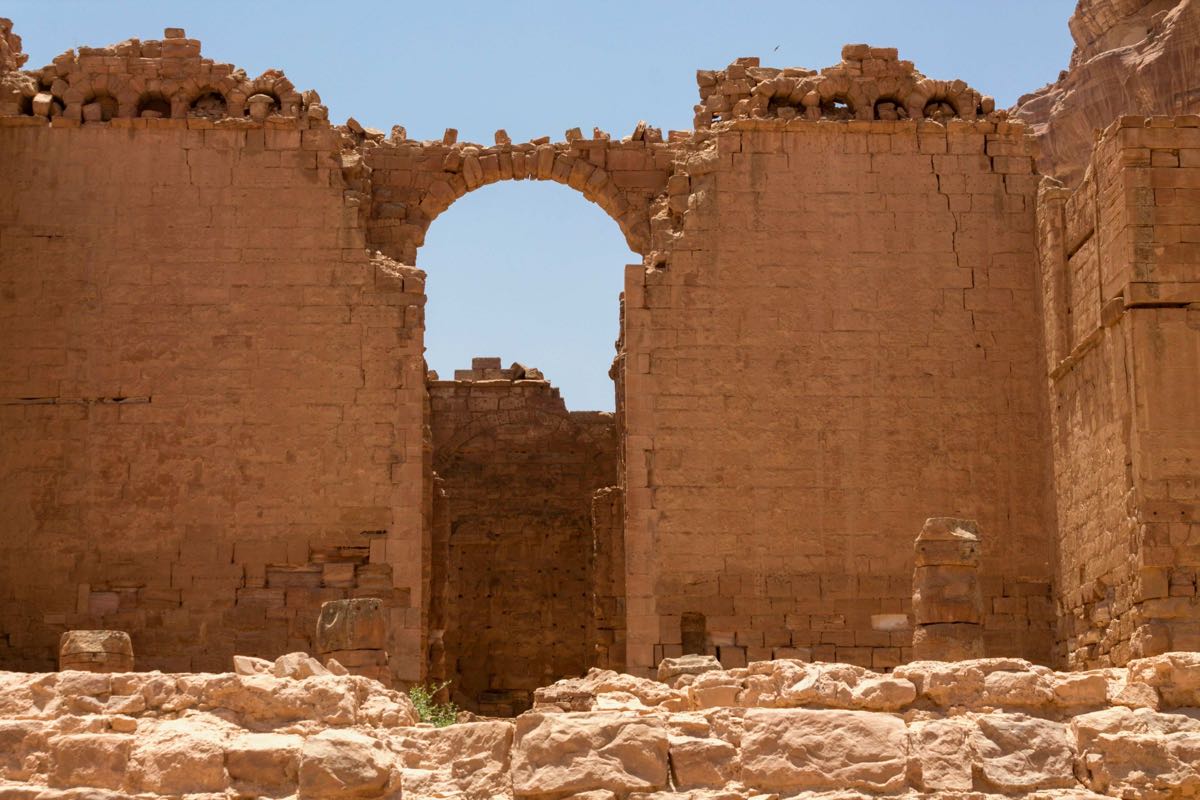
The fortifications that studded the ridge roads and trade routes of medieval Jordan were not decorative. They were instruments of economic control, command posts for military operations, and, occasionally, stages for some of the more dramatic personal behaviour recorded in Crusader-era chronicles. To understand Karak Castle is to understand why Saladin besieged it twice with the full force of the Ayyubid army before he could pass it.
Jordan’s major medieval castles divide into two categories that reflect the conflict of their era: Crusader fortifications built by the Frankish kingdoms of Jerusalem to control the roads south of the Dead Sea, and Ayyubid fortifications built by Saladin’s successor state specifically to counter them. Both kinds survive, and both are worth visiting for reasons that go well beyond the architecture.
Karak Castle
Karak (ancient Charachmoba) sits on a triangular plateau 900 metres above sea level, its eastern cliff falling away to the Wadi Karak below. The town of Karak grew up around the castle over the centuries and now surrounds it on three sides; the approach through the town centre ends at the castle gate with an abruptness that makes the transition between ordinary street and medieval fortification more striking than at most sites of this kind.
The Knights Hospitaller - the Crusader military order responsible for castle building and defense across the Levant - completed the basic structure of Karak Castle in 1142 CE under the direction of Payen the Butler, lord of Oultrejordain. Its position controlled the King’s Highway, the ancient trade and military road running the length of the Jordanian plateau from Damascus to the Red Sea. Any caravan or army moving along this route had to pass under the walls of Karak.
The most notorious period in Karak’s history is associated with Reynald de Châtillon, who became lord of Oultrejordain in 1177 after marrying the widow of the previous lord. Reynald used Karak as a base for behaviour that was extreme even by the aggressive standards of Crusader frontier politics. His attack on a Muslim pilgrim caravan crossing the King’s Highway in 1186 - breaking a truce that was supposed to guarantee safe passage - was a direct cause of Saladin’s decision to invade the Crusader kingdoms. This led to the Battle of Hattin (1187), the destruction of the Crusader field army, and the fall of Jerusalem.
Saladin besieged Karak in 1183 and again in 1184, neither siege succeeding. There is an episode recorded in chronicles of the 1183 siege during which a wedding was being celebrated inside the castle. The bride’s mother reportedly sent food to Saladin outside the walls; he is said to have responded by asking which tower the newlyweds would occupy so that he could direct his siege engines elsewhere. Historians note that this may be a later embellishment, but the episode appears in multiple medieval sources.
Karak finally fell to Saladin in 1189, after Reynald’s death at Saladin’s own hand following the Battle of Hattin. The Ayyubids held it until Crusader forces briefly retook the region in the 13th century during the later Crusades. The Mamluks - who succeeded the Ayyubids - controlled it from 1263 onward and substantially rebuilt sections of the fortifications.
Inside Karak: the castle is large enough to spend two hours exploring. The lower levels contain the Crusader-era vaulted galleries - rooms carved into the rock beneath the main fortifications, used for stabling, storage, and as barracks. The museum within the castle (included in admission) has maps, carved stonework, and explanatory panels. The upper levels offer views across the Wadi Karak and south toward Shobak.
Entry: approximately JOD 3 as of 2026. Open daily 8am–5pm. A small cafe operates near the entrance. Karak is 120 kilometres south of Amman; by car via the King’s Highway it takes approximately 2 hours. JETT buses run to Karak (JOD 2.5, 2 hours) from Amman’s South Bus Station.
Ajloun Castle
Ajloun Castle - properly Qal’at ar-Rabad - stands on a forested hilltop 80 kilometres north of Amman, surrounded by oak woodland that feels entirely different from the dry escarpments of the south. The drive from Jerash (30 minutes away) through the pine and olive trees on the approach to Ajloun is one of the unexpectedly pleasant transitions in Jordanian travel.
The castle was built in 1184 CE on the orders of Izz al-Din Usama, a nephew of Saladin governing the region. Its purpose was explicit: to counter the Crusader fortresses that commanded the routes through the Jordan Valley and to protect the iron mines at Ajloun that supplied the Ayyubid military. The design - a central keep with four corner towers, surrounded by a moat - is Islamic military architecture rather than Crusader; compare it to Karak and the differences in design philosophy are immediately visible.
Ajloun was not involved in major sieges or dramatic historical episodes in the way that Karak was. Its military significance lay in its position: it closed off the routes by which Crusader forces might move east from the Jordan Valley into the interior. After the Crusader kingdoms collapsed in the late 13th century, the castle continued to function as an administrative centre under Mamluk and later Ottoman rule.
The interior is more complete than Karak in some respects. The vaulted rooms on multiple levels retain their stone ceiling ribs. The Ajloun Castle Museum, housed in a room adjacent to the main entrance, displays pottery, glass, metalwork, and coins from various periods of occupation. The views from the towers across the Jordan Valley toward the West Bank are clear on most mornings.
Entry: approximately JOD 3 as of 2026. Open daily 8am–5pm (4pm in winter). From Jerash, minibuses run to Ajloun town (JOD 0.5, 30 minutes); the castle is a further 3 kilometres uphill - take a taxi from town for approximately JOD 2.
Shobak Castle (Montreal)
Shobak - known to the Crusaders as Montreal - is the oldest of Jordan’s major Crusader fortifications and the least visited. It was built in 1115 CE by Baldwin I of Jerusalem, the first Latin King of Jerusalem, as the southernmost Frankish stronghold, controlling the road junction between the King’s Highway and the routes to the Red Sea.
Unlike Karak or Ajloun, Shobak never saw a decisive siege that removed it from one power’s control to another’s in a single dramatic event. It changed hands gradually, passed through Ayyubid and Mamluk control, and was partly occupied and modified over several centuries. The Mamluk restoration work is visible in the carved inscriptions on the towers.
The castle sits on a conical hill with the remains of the medieval settlement on its slopes. The interior is less stabilised than Karak - there are areas of tumbled masonry and exposed drops - which gives the visit a rougher quality that some find more atmospherically honest than the more restored sites. A long underground passage descends through the rock to a spring below the castle level; this water source was the strategic basis for the site’s selection and is still accessible with a torch (bring one).
Entry: approximately JOD 3 as of 2026. Open daily 8am–5pm. Shobak is 25 kilometres north of Petra on the King’s Highway - convenient for combining with a Petra visit. There is no public transport to the castle; a taxi from Petra (Wadi Musa) costs approximately JOD 25–35 return with waiting time. A rental car makes Shobak, Karak, and Petra a logical multi-day southern Jordan circuit.
Planning the Castles as a Route
The most logical way to see all three major castles is as part of a King’s Highway drive between Amman and Petra. The recommended sequence from north to south: Madaba and Mount Nebo (Byzantine mosaics) → Karak Castle (overnight in Karak town is possible - basic guesthouses from JOD 25–40) → Shobak Castle → Petra.
Ajloun pairs naturally with Jerash on a northern day trip from Amman and is not on the King’s Highway route - it requires a separate excursion.
A private driver for the full King’s Highway route from Amman to Petra (one day, stopping at Madaba, Mount Nebo, Karak, and optionally Shobak) costs approximately JOD 80–120 depending on negotiation and the number of stops. Rental car is cheaper if you are comfortable with Jordan’s road conditions and occasional unmarked junctions on the older road sections. Airport and intercity transfers can be pre-booked if you prefer a fixed price and a meet-and-greet.
See also: Karak City Guide · Ajloun City Guide · Things to Do in Karak · Things to Do in Ajloun · 7-Day Jordan Itinerary · Jordan Pass Guide