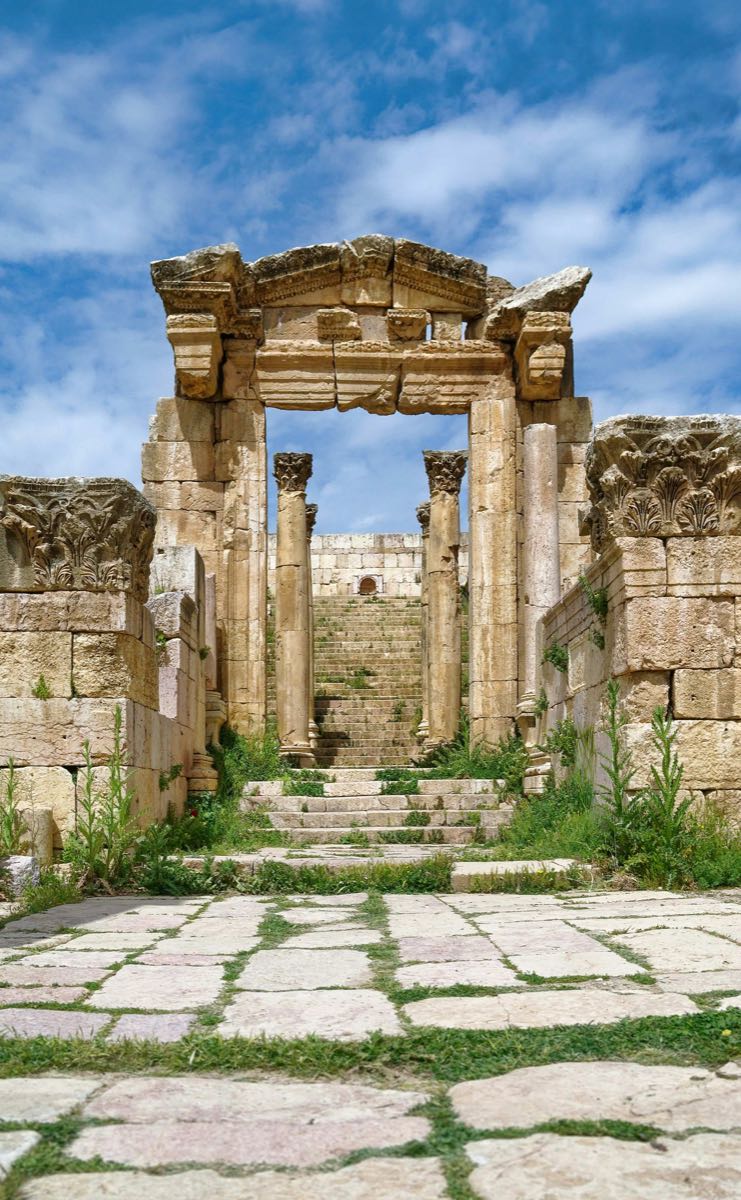
Jerash sits 48 kilometres north of Amman in a broad valley watered by the Zarqa River. The modern town goes about its business on the eastern edge of an archaeological site that contains, almost completely intact, the street grid, public buildings, temples, theatre, and colonnaded avenues of a prosperous Roman city. What survived at Jerash is not a few columns on a hillside but an entire urban plan - the kind of thing that helps you understand, at a visceral level, what a Roman city actually felt like to inhabit.
Archaeologists rank Jerash alongside Pompeii and Ephesus as among the best-preserved Roman urban sites in the world. Unlike Pompeii, Jerash was not frozen by disaster - it simply declined slowly enough that no substantial later city was built on top of it.
From Hellenistic Settlement to Roman Prosperity
The valley that would become Gerasa was settled long before the Romans arrived. Archaeological evidence points to Bronze Age occupation, and the Hellenistic period - following Alexander the Great’s campaigns through the region in the 330s BCE - saw the establishment of a more organised settlement. The name Gerasa may derive from an earlier Semitic place name; its etymology remains contested.
Roman control consolidated after Pompey’s eastern campaigns in 63 BCE. Over the following two centuries, Gerasa developed into a significant city of the Decapolis - a loose league of ten Hellenised urban centres in the region corresponding roughly to modern Jordan and southern Syria. Membership in the Decapolis was less a formal political structure than a shared cultural identity: Greek language, Roman-influenced urban planning, classical architecture, and commercial integration with the wider Mediterranean economy.
At its peak in the 2nd and early 3rd centuries CE, Gerasa had a population estimated at 15,000 to 20,000 people, with a further agricultural population in the surrounding territory.
Hadrian’s Arch and the Imperial Visit
The most visible external marker of Jerash’s prosperity is the triumphal arch that stands just south of the main walled city. Hadrian’s Arch was constructed in 129–130 CE to celebrate the visit of the Emperor Hadrian - a rare imperial presence in a provincial city and a mark of Jerash’s status.
The arch stands 21 metres high and was designed with space for flanking towers, suggesting the original plan may have been to extend the city’s southern wall to incorporate it. That expansion never happened, leaving the arch standing in open ground - which makes it easier to photograph and easier to appreciate its scale. The detail of the carved stonework, even after nearly 1,900 years of exposure, remains clear.
The Oval Plaza
Walking north from Hadrian’s Arch through the South Gate, you enter the Oval Plaza - technically an elongated ellipse rather than a true oval, with 56 Ionic columns still standing around most of its perimeter. This is one of the most unusual public spaces in the Roman world. Roman urban planning convention dictated a rectangular forum; the elongated oval at Gerasa is found almost nowhere else in Roman architecture and its function is debated. It likely served as the monumental transition between the road from the south and the main colonnaded street of the city.
The columns you see today are original Roman-era stone. The bases and much of the entablature have been reconstructed from collapsed fragments, but the standing columns themselves have been in place for nearly two millennia.
The Cardo Maximus
North from the Oval Plaza runs the Cardo Maximus - the main north-south colonnaded street - for roughly 800 metres. Walking this street is the best way to understand the Roman experience of Gerasa at scale. The columns line both sides; the stone paving is original and the marks of chariot wheels ground into the limestone over centuries are still clearly visible. Drainage channels run beneath the paving. At intervals, cross streets intersect the Cardo in the Roman urban grid pattern.
The street was lined with shops at ground level - tabernae - opening behind the colonnades. In Roman cities these were the commercial face of the city, selling cloth, metalwork, food, and the daily goods of urban life. The archaeology of the surrounding buildings, still mostly unexcavated, suggests the residential quarters beyond the colonnades were dense and varied.
The South Theatre
The South Theatre is the larger of Jerash’s two theatres, seating approximately 3,000 spectators in a well-preserved cavea (seating bowl) cut partly into the hillside. What makes the South Theatre distinctive is that it still functions - it is used annually for the Jerash Festival of Culture and Arts, held in July and August, and the acoustics remain what Roman architects intended: a speaker at the stage centre can be heard clearly at the back of the uppermost tier without amplification.
The stage building (scaenae frons) retains much of its original structure, including niches that once held statues. Climbing to the upper seating tiers gives one of the best elevated views across the entire archaeological site.
The Temple of Artemis
Gerasa’s patron deity was Artemis, goddess of the hunt, and her temple was the largest religious building in the city. The Temple of Artemis stands on a high podium approached by a monumental stairway and a processional way that led directly from the Cardo. Twelve of the original columns remain standing, and they are notable for something observable in strong winds: the columns sway very slightly, demonstrating the engineering principle by which Roman architects built flexibility into large stone structures to prevent earthquake fracturing.
The precinct around the temple - the temenos - was enormous, covering an area larger than many modern city blocks. Within it, smaller shrines, altars, and administrative buildings served the religious and civic functions of the city.
The Hippodrome and Roman Army Experience
Immediately south of the South Gate lies a long rectangular enclosure - the Hippodrome, which once held chariot races and athletic competitions for Gerasa’s population. At 244 metres long, it was a substantial facility capable of seating 15,000 spectators, though it was probably never used at full capacity during the city’s later centuries.
Today the Hippodrome hosts the Roman Army and Chariot Experience - a recreation of Roman military drills and chariot racing performed by a local troupe using period-accurate equipment. It runs at 11am and 2pm most days (confirm times at the visitor centre). The admission is approximately JOD 8 in addition to the site entry fee. The performance is good value for anyone with children or with an interest in military history; it gives concrete context for the abstract scale of the Hippodrome.
Decline and Preservation
Gerasa’s decline began with the Persian invasion of 614 CE, which disrupted the administrative and commercial structures that sustained urban life. The Arab conquest of 636 CE was not accompanied by destruction - early Islamic Jerash shows evidence of continuity, including a mosque built from reused Roman-era stone - but population fell steadily.
The earthquake of 749 CE was catastrophic. Much of the colonnaded street was thrown down; temples and public buildings suffered major structural damage. The population, already diminished, dispersed. The ruins sat largely undisturbed through the medieval period, quarried occasionally for building material by nearby villages but otherwise untouched.
Systematic archaeological excavation began in the 1920s, led by British and American teams. Work has continued since, with the pace accelerating after the site was opened to tourism. Large sections remain unexcavated - Jerash is still yielding significant discoveries. In 2022, a Roman-era residential building was uncovered containing a well-preserved mosaic floor depicting mythological scenes.
Practical Information
Entry fee: approximately JOD 10 for international visitors as of 2026. Included in the Jordan Pass. Opening hours: daily 8am–6pm (April–October); daily 8am–4pm (November–March). Arrive early to walk the Cardo before tour groups arrive.
Getting there from Amman: JETT bus from North Bus Station (Tabarbour), approximately JOD 1.5 one-way, journey one hour. Private taxi JOD 25–35 one-way. Organised day tours from Amman include Jerash with transport for approximately JOD 30–50 per person.
On site: there is a visitor centre with maps at the entrance. A small cafe operates near the South Theatre. The site has uneven stone paving throughout - avoid sandals.
See Also
To see Jerash with a guide, our best tours in Jerash roundup compares half-day and full-day options.