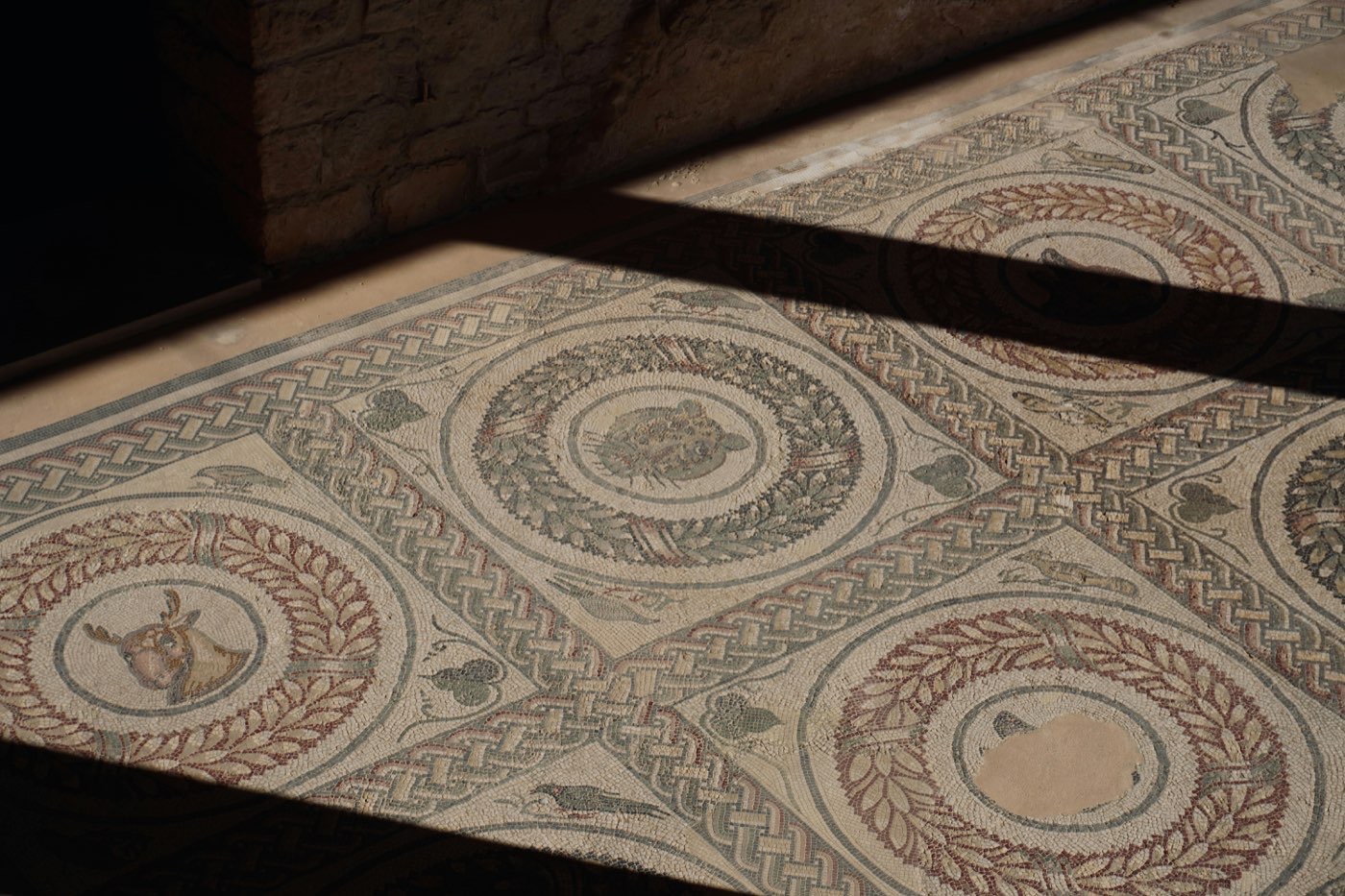
The floor mosaics of Jordan’s Byzantine period represent one of the most significant concentrations of this art form anywhere in the world. While Italian and Turkish cities have famous mosaics, Jordan’s collection is distinguished by its geographical scope - sites spread across a 150-kilometre north-south corridor - and by the survival of several pieces in remarkable condition despite 1,400 years without the protective enclosure that most comparable Roman and Byzantine mosaics enjoy. They were simply buried under centuries of rubble and soil, which turned out to be the best preservation strategy available.
The three most significant sites - Madaba, Mount Nebo, and Umm ar-Rasas - can be combined in a single long day from Amman. Each rewards more time than that.
What Byzantine Mosaics Are and Why Jordan Has So Many
Byzantine mosaics are floor and wall decorations made from small coloured stone, glass, or ceramic cubes (tesserae) set into a mortar bed. The technique was inherited from Greco-Roman practice but expanded dramatically during the Christian Byzantine period, when church construction throughout the eastern Mediterranean created enormous demand for decorative floors that could withstand heavy foot traffic while conveying theological and cosmological narratives.
The eastern Roman provinces - roughly modern Jordan, Syria, Lebanon, Israel, and Palestine - were among the wealthiest and most populous parts of the empire in the 4th to 7th centuries CE. Petra had declined but other Jordanian cities flourished: Madaba, Jerash (Gerasa), Philadelphia (Amman), and Esbus. The church construction programme that accompanied the Christianisation of the empire after Constantine (313 CE) produced dozens of significant mosaic floors throughout the region.
Jordan has fared better than neighbouring countries in terms of preservation for two reasons: lower overall population density in the post-Byzantine period reduced the rate of stone robbing and construction over ancient sites; and the particular dryness of the climate once sites were buried prevented the water infiltration that destroys mortar beds in wetter regions.
The Madaba Map
The town of Madaba, 30 kilometres south of Amman on the road to Petra, contains the most famous of all Byzantine floor mosaics: the Madaba Map, housed in the Greek Orthodox Church of St George.
The map was created in the mid-6th century CE - probably between 542 and 570 CE, based on internal evidence - as the floor of an earlier church on the same site. It depicted the entire eastern Mediterranean world from Lebanon and Syria in the north to the Nile Delta in the south, and from the Mediterranean coast eastward into the Arabian desert. It contained an estimated two million tesserae and measured approximately 16 metres by 6 metres in its original extent.
The map is oriented with east at the top - the convention in Byzantine cartography, which placed Jerusalem at the symbolic centre. That city occupies the largest and most detailed section of the surviving portion: a recognisable bird’s-eye view of 6th-century Jerusalem showing the Cardo Maximus (the main colonnaded street), the Church of the Holy Sepulchre, the Damascus Gate, the Lions’ Gate, and dozens of other identifiable structures. It is the oldest surviving cartographic representation of the Holy Land and a primary historical source for the urban geography of the period.
When the current St George’s Church was rebuilt in 1894, workers uncovered the mosaic. A significant portion had already been destroyed in the construction process before the value of what remained was understood. The surviving section - roughly a third of the original area - was incorporated into the rebuilt church floor and is visible today behind a wooden viewing platform.
Entry to St George’s Church is free (a donation is welcome). The church is open daily from approximately 8am to 6pm, with earlier closing on Sundays during services. Photography is permitted.
Madaba Archaeological Park
A five-minute walk from St George’s Church, the Madaba Archaeological Park contains five separate mosaic sites within a single enclosed area. The most significant is the Church of the Virgin Mary (6th century), which has a well-preserved section of geometric and vegetal mosaic with medallions containing animal and bird figures. The nearby Hippolytus Hall preserves a complex mythological scene - the earliest known depiction of the myth of Phaedra and Hippolytus in mosaic - of unusually high artistic quality.
The park also contains the Church of the Prophet Elias, the Crypt of Elianus, and several private houses with domestic mosaic floors. The combination of religious and secular mosaics in a small area illustrates the breadth of 6th-century mosaic use.
Entry to Madaba Archaeological Park: approximately JOD 3 as of 2026. Open daily 8am–5pm (4pm November–March). The Jordan Pass does not cover this site; bring cash.
The Apostles Church, a five-minute walk south of the park, has a separate admission (approximately JOD 2) and contains a complete geometric mosaic floor with a central personification of the sea - an unusual subject in a landlocked city.
Mount Nebo
Ten kilometres northwest of Madaba, Mount Nebo is the site where the Old Testament places the death of Moses - he was permitted to see the Promised Land from the summit but not to enter it. The mountain is a place of pilgrimage for Christian, Jewish, and Muslim visitors, and a memorial church has stood here since at least the 4th century CE.
The current basilica - properly the Memorial Church of Moses - was extensively excavated and partially restored by the Franciscan Archaeological Institute from the 1930s onward. The mosaics it contains are among the finest produced in Byzantine Jordan. The main floor mosaic (530 CE) depicts an elaborate hunting scene: hunters on horseback and on foot pursuing lions, bears, and other animals, surrounded by a border of vintage scenes (grape harvesting, wine pressing) and pastoral imagery. The draftsmanship is exceptional - individual animals are rendered with anatomical specificity rare in floor mosaics of the period.
The outdoor terrace behind the basilica holds a modern sculpture - a serpentine cross representing the bronze serpent of the Old Testament - and offers one of the clearest views in Jordan: on clear days you can see Jerusalem, the Dead Sea, the Jordan River valley, and, reportedly, the lights of Tel Aviv after dark.
Entry to Mount Nebo: approximately JOD 2 as of 2026. Open daily 8am–6pm (5pm winter). A small museum adjacent to the basilica displays smaller mosaic fragments and carved architectural elements.
Umm ar-Rasas
Umm ar-Rasas, 70 kilometres south of Madaba on an unpaved track off the King’s Highway, is the most remote and least visited of the major mosaic sites - and in some respects the most rewarding precisely because of that. The site received UNESCO World Heritage status in 2004.
The ancient city of Kastron Mefaa (its Byzantine-era name) was occupied from the Roman period through the Abbasid period - an unusually long continuity. The most remarkable structure is the Church of St Stephen, dating from 785 CE: meaning the mosaic floor was laid more than 150 years after the Arab conquest of the region. The craftsmen were apparently still working in the Byzantine tradition long after Byzantine political authority had ended.
The St Stephen mosaic is a large-scale composition depicting a map of the region: towns and cities along the Nile, towns in the Holy Land (some also appearing on the Madaba Map), and detailed scenes of rural and urban life. The quality is high and the topographic detail is historically significant - several cities depicted are known only from this mosaic. Surrounding the central map are hunting and farming scenes with a freshness and movement unusual in floor mosaic conventions.
The site also contains a tall, isolated tower - a Stylite tower, where Christian ascetics lived on elevated platforms for years at a time, visible from kilometres away on the flat plateau.
Entry to Umm ar-Rasas: approximately JOD 3 as of 2026. The site has limited facilities - bring water and food. The paved approach road ends several kilometres before the site; access requires a vehicle capable of unpaved tracks or booking a guided tour. Tours from Madaba or Amman can be arranged through local operators for approximately JOD 40–60 per person.
Practical Planning
A logical itinerary combines these sites in one day from Amman, driving south on the Dead Sea Highway or the Desert Highway. The sequence that works best geographically: Madaba Archaeological Park → St George’s Church → Apostles Church (morning) → Mount Nebo (midday, combine with the panoramic view) → continue south on the King’s Highway toward Karak or Petra, OR return to Amman via the Dead Sea road.
Umm ar-Rasas is best visited as a dedicated half-day from Madaba with a rental car or private driver - public transport does not serve the site. A private driver from Madaba for the round trip costs approximately JOD 30–40.
Hiring a guide in Madaba makes the most of the Archaeological Park especially - the multi-phase construction history and the relationships between adjacent buildings are not clearly explained by the on-site panels. Local guides can be arranged at the Madaba visitor centre for approximately JOD 20–30 for a half-day. Day tours from Amman covering Madaba, Mount Nebo, and the mosaic sites are available if you prefer guided transport included.
See also: Madaba City Guide · Mount Nebo Visitor Guide · Things to Do in Madaba · Things to Do at Mount Nebo · 3 Days in Amman Itinerary · 7-Day Jordan Itinerary