Mount Nebo: Moses's Viewpoint, Entry Fees & Hours
Mount Nebo: open 8am–6pm daily, entry JOD 2. Views over the Dead Sea, Byzantine mosaics, and the Brazen Serpent sculpture at Moses's summit.
Guides for Mount Nebo
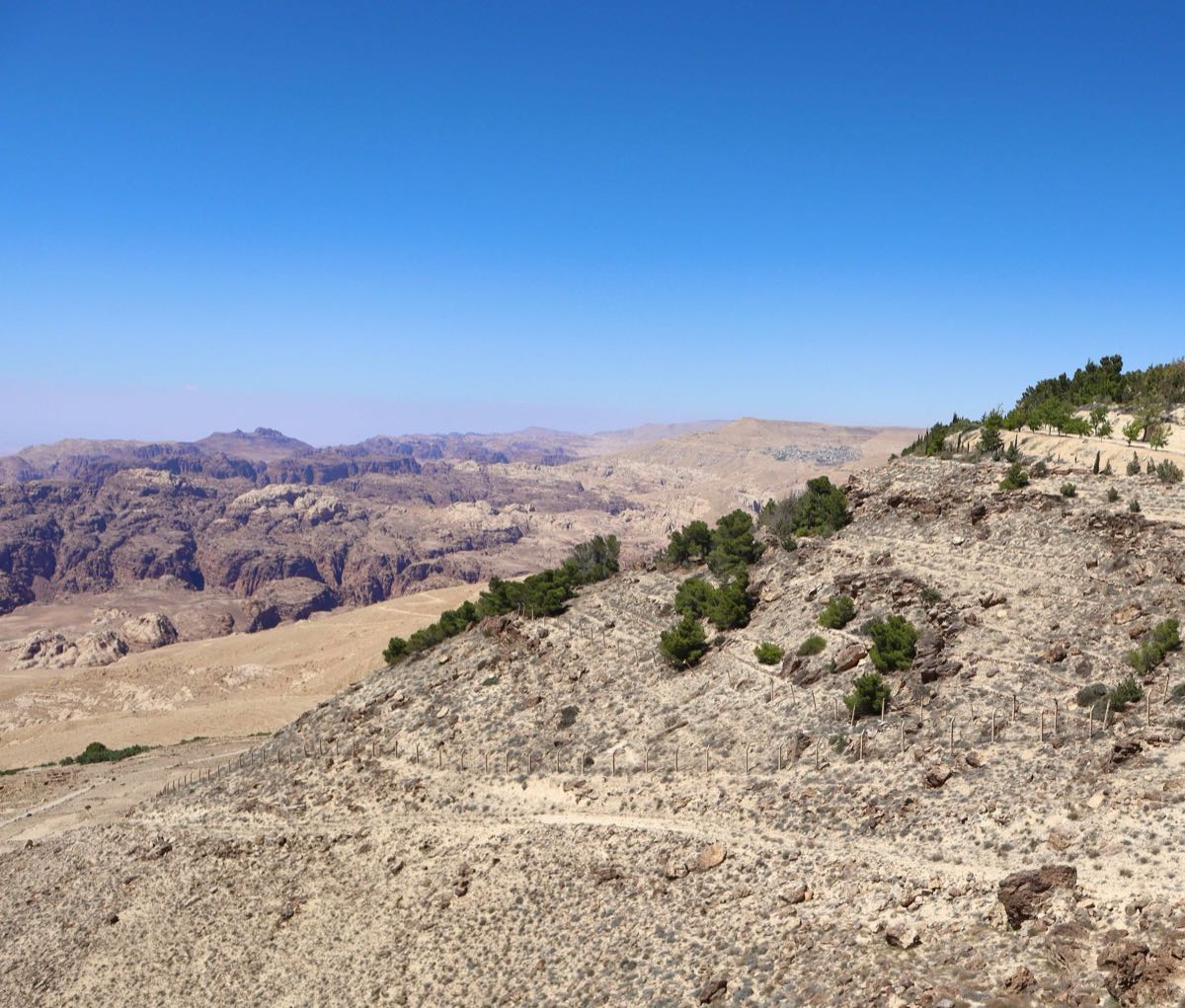
Mount Nebo rises to 817 metres above sea level on the plateau east of the Dead Sea, the summit giving a panorama that takes in the Jordan Valley floor, the northern end of the Dead Sea, and - on clear days - Jerusalem, Bethlehem, and the hills of Judea beyond. According to the Book of Deuteronomy (34:1–5), this is where Moses stood to see the land that God had promised to Abraham’s descendants, and where he died without crossing over. The claim cannot be verified, but the setting is impossible to dismiss: few viewpoints anywhere in the region give such a geographically and historically charged sight line.
The site is managed as a Christian pilgrimage and archaeological destination, with Byzantine church remains, outstanding mosaic floors, and a striking modern sculptural installation. It is most logically combined with Madaba - 9km to the east - and can be visited as a half-day stop on the way between Amman and Petra.
The Memorial Church of Moses
The church occupying the summit was first constructed in the 4th century AD, when early Christian communities began identifying the site with the biblical narrative. Byzantine pilgrims were already visiting Mount Nebo by the late 300s, and the church was expanded and embellished through the 5th and 6th centuries before falling into disuse following the Arab conquest of the region.
Archaeological excavations beginning in the 1930s, conducted by the Franciscan Archaeological Institute, uncovered the church’s extent and, crucially, its mosaic floors. The mosaics are the principal reason to visit. Dating from the 6th century, they depict hunting and pastoral scenes - figures pursuing deer, lions, and ostriches; a shepherd leading his flock; trees bearing pomegranates and grapes. The geometric border work and the naturalistic rendering of animals are both of high quality, comparing favourably with the better-known mosaics in Madaba.
Entry costs approximately JOD 2 as of 2026. Opening hours are daily 8am to 6pm. A Jordan Pass covers admission. The site is managed by the Franciscan Custody of the Holy Land, and a small bookshop near the entrance sells publications on the archaeology and biblical context of the site.
Allow 1 to 1.5 hours for a thorough visit: the church interior and its mosaics, the archaeological remains outside, the Brazen Serpent Monument, and the viewpoint. Guided tours are available through most Amman and Madaba-based operators for those who want context beyond the on-site information panels.
The Brazen Serpent Monument
Standing at the summit viewpoint directly above the Jordan Valley, the Brazen Serpent Monument was created by Italian artist Giovanni Fantoni and erected in 2000 as a gift from Pope John Paul II’s visit to the site. The bronze sculpture intertwines two elements from different biblical narratives: the serpent that Moses raised on a pole to heal those bitten in the wilderness (Numbers 21:8–9) and the cross of the Christian crucifixion narrative - a linking that follows the reference in John 3:14 (“Just as Moses lifted up the snake in the wilderness, so the Son of Man must be lifted up”).
The sculpture stands roughly 4 metres high and is positioned to frame the view westward. Whether or not the iconographic intention is meaningful to you, the silhouette of the twisted metal against the Dead Sea and the hills beyond makes it the site’s most photographed element, and deliberately so.
The View
At 817 metres, Mount Nebo’s western escarpment drops steeply into the Jordan Valley, which runs roughly 400 metres below sea level at the Dead Sea shoreline directly below. The altitude difference is among the greatest of any short horizontal distance anywhere on earth.
On a clear morning in spring or autumn, the view from the summit encompasses:
- The Dead Sea - the northern shoreline directly below, the Israeli shore visible on the opposite bank
- The Jordan Valley floor - the winding course of the river lost in the agricultural flatlands
- Jericho - the oldest continuously occupied city in the world, visible as a green patch in the valley
- Jerusalem - approximately 46km west, identifiable by the glint of the Dome of the Rock on clear days
- The Judean Hills - rolling uplands beyond Jerusalem extending south
Summer haze and heat shimmer substantially reduce visibility; the best viewing conditions are on clear winter days, early spring mornings (March–April), or late autumn (October–November). Arrive early - by 9am - before atmospheric haze builds.
Nearby: Madaba
Madaba, 9km east of Mount Nebo on the plateau, is the obvious companion stop and should be included in any itinerary that brings you to the summit. The town is famous for the Madaba Map - a 6th-century Byzantine mosaic floor map of the Holy Land preserved in the floor of Saint George’s Church, showing Jerusalem, the Jordan River, and surrounding cities in remarkable geographic detail. Entry to Saint George’s Church costs approximately JOD 1 as of 2026; the church opens around 8am and closes in the early afternoon on Sundays.
Madaba also has a good selection of restaurants and mosaic craft shops, and it functions well as a lunch stop on the route between Mount Nebo and the Dead Sea or Petra.
Nearby: Machaerus (Mukawir)
Approximately 35km south of Madaba and accessible by car, the fortress of Machaerus - known locally as Mukawir - sits on a dramatic hilltop above a valley west of the King’s Highway. The fortress is identified in the writings of the Jewish historian Josephus as the site where John the Baptist was imprisoned by Herod Antipas and subsequently beheaded. Archaeological excavations have confirmed the presence of a substantial Herodian palace and fortress on the summit. The views are outstanding and the site is significantly less visited than Mount Nebo - a combination worth noting if you have time. Entry is approximately JOD 2 as of 2026; the site is open daily.
Where to Stay Near Mount Nebo
Mount Nebo itself has no accommodation. The obvious base is Madaba, 9km to the east.
Mariam Hotel, Madaba - The most consistently recommended mid-range option in Madaba, family-run and well-positioned near the town centre and Saint George’s Church. Rates run approximately JOD 30–40 per night as of 2026, including breakfast. Staff are experienced with pilgrimage itineraries and can arrange transport to Mount Nebo, the Dead Sea, and further south.
Mosaic City Hotel, Madaba - A more recent boutique option in the town centre, with rooms decorated with local craft and mosaic work. Rates approximately JOD 35–50 per night as of 2026. A short walk from Saint George’s Church and Madaba’s restaurant strip.
For visitors making Mount Nebo a stop on the Amman-to-Petra drive, staying overnight is not necessary - the site is compact and the drive south continues comfortably after a 1.5-hour visit.
Search hotels in Mount Nebo on Booking.com
Getting to Mount Nebo
From Madaba: The most straightforward approach. Madaba is 9km east of the summit; a taxi from Madaba to Mount Nebo and back, with waiting time, costs approximately JOD 5–8 as of 2026. Drivers will typically wait at the site while you visit if you agree the return fare in advance. Some Madaba hotels can arrange shared transport for groups.
From Amman: Approximately 40km southwest, around 50 minutes by car in normal traffic. Most visitors drive directly to Madaba first (30–40 minutes from Amman via the Dead Sea Road or the Desert Highway), then continue to Mount Nebo. A private taxi from Amman for a half-day covering both Madaba and Mount Nebo costs approximately JOD 25–40 as of 2026 depending on negotiation and waiting time. Public buses connect Amman with Madaba (from South Station, Wahdat, approximately JOD 0.70, 30–40 minutes) - from Madaba, take a local taxi to the summit.
On the road to Petra: Mount Nebo sits 40km from Amman in the direction of Petra, making it a logical first stop on the southward drive. The King’s Highway continues south from Madaba through Karak and Wadi Musa, with Mount Nebo an easy morning start before the longer drive south. To join a guided tour from Amman that includes Mount Nebo, Madaba, and the Dead Sea in a single day, browse Jordan tours covering these sites.
More at Mount Nebo
- Things to Do at Mount Nebo
- Where to Stay Near Mount Nebo
- Food Near Mount Nebo
- Byzantine Mosaics in Jordan: Madaba and Beyond
- Madaba City Guide
- Dead Sea Jordan Guide
Planning an overnight near the mountain? Our Mount Nebo hotels guide compares stays by area and budget.
Book an experience
Top experiences in Mount Nebo
Explore the best tours and activities in Mount Nebo , with instant confirmation and free cancellation on most bookings.
Frequently Asked Questions
- How do you get to Mount Nebo from Amman?
- Mount Nebo is approximately 40km southwest of Amman, around 50 minutes by car. Most visitors combine it with Madaba (9km east of the summit), making the drive from Amman to Madaba first (around 30–40 minutes), then continuing by taxi or car to the summit. A taxi from Madaba to the summit and back costs approximately JOD 5–8 and drivers will usually wait while you visit.
- What is the entry fee for Mount Nebo?
- Entry to the Mount Nebo archaeological site and Memorial Church of Moses costs approximately JOD 2 as of 2026. The site is open daily from 8am to 6pm. A Jordan Pass covers admission. Allow 1 to 1.5 hours for a thorough visit including the church mosaics and the viewpoint.
- Can you see Jerusalem from Mount Nebo?
- On clear days, yes. At 817 metres above sea level with an unobstructed westward panorama, Mount Nebo offers views across the Jordan Valley to Jerusalem (approximately 46km as the crow flies), the Dead Sea directly below, and on very clear days the hills of Judea beyond. Haze and heat shimmer reduce visibility significantly in summer; spring and autumn mornings give the best conditions.
- What is the Brazen Serpent Monument at Mount Nebo?
- The Brazen Serpent Monument is a modern bronze sculpture by Italian artist Giovanni Fantoni, erected in 2000. It represents the bronze serpent that Moses raised on a pole in the wilderness, described in Numbers 21:8–9, which Jesus later references in John 3:14. The sculpture intertwines the serpent of Moses with the cross - it stands at the summit viewpoint and is the site's most photographed element.