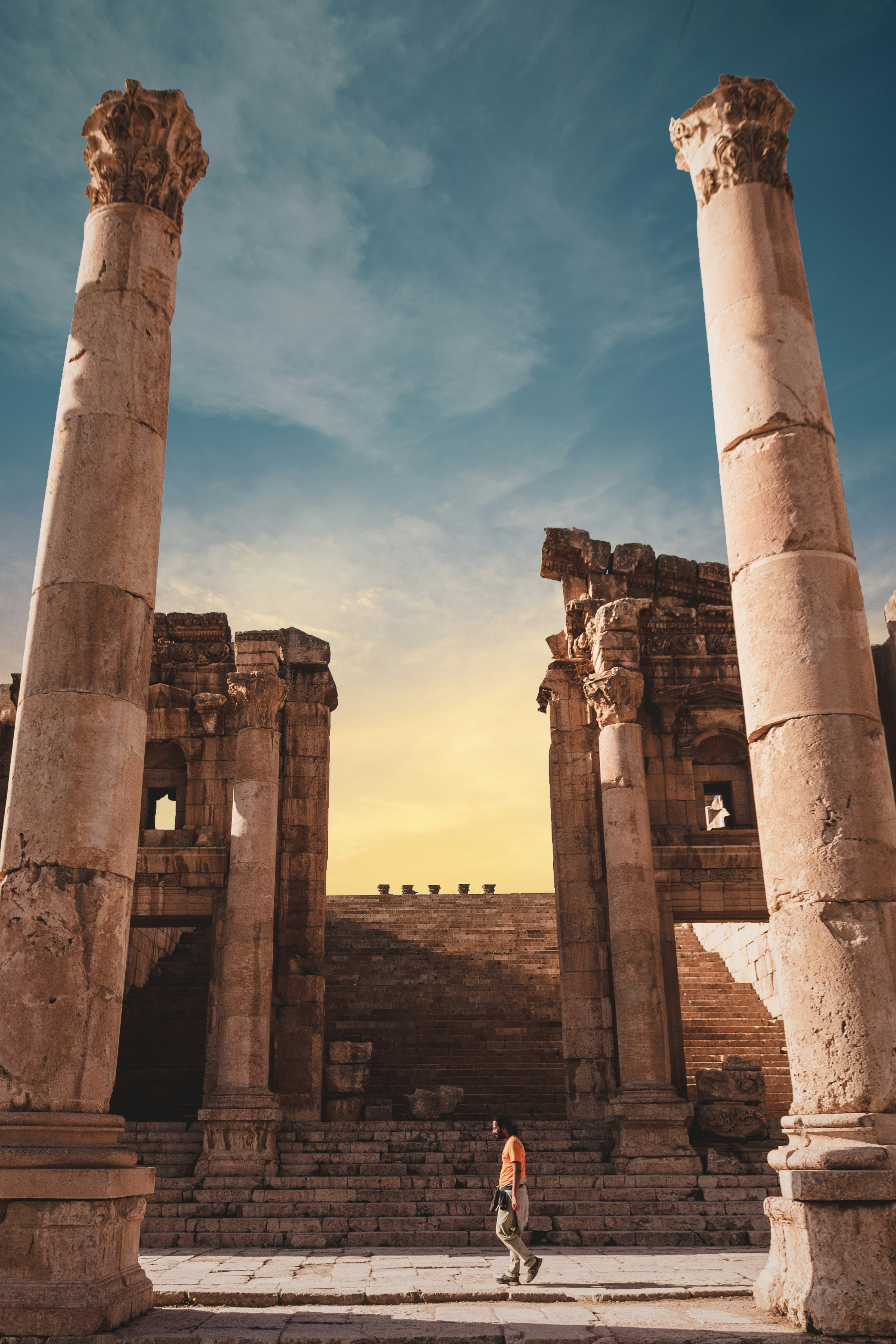
Jerash Jordan: Roman Ruins Visitor Guide
Visit Jerash, one of the world's best-preserved Roman cities. Entry fees, opening hours, the RACE show, hotels, and transport from Amman.
Guides for Jerash
Jerash has been continuously inhabited for roughly 6,500 years. The Greek city of Antioch on the Chrysorhoas, renamed Gerasa under Roman administration, grew into one of the most prosperous cities of the Decapolis - the ten semi-autonomous Greco-Roman cities of the eastern empire. What remains today is the most complete example of a Roman provincial city outside Italy and North Africa, preserved by an unusual combination of factors: the city declined gradually rather than burning, it was buried under silt from centuries of flooding, and the desert climate did the rest.
Walking into the site from Hadrian’s Arch, the scale becomes apparent almost immediately. This is not a collection of fragments - it is a city. The columns are still standing. The paving stones still carry the ruts from Roman cart wheels. The theatre still seats audiences.
Getting to Jerash
Jerash is 48 km north of Amman - approximately one hour by car via the Amman-Jerash Highway.
The cheapest option from Amman is a minibus from the North Bus Station (Tabarbour) to Jerash, costing approximately JOD 1.50 per person. Services run frequently through the morning. The minibus drops you near the modern town centre, from which the ancient site is a short walk or a brief taxi ride.
A private taxi from central Amman to Jerash runs approximately JOD 15–20 one-way. Many taxi drivers offer a half-day rate that includes waiting while you visit - ask about this at your hotel.
Organised day tours from Amman typically combine Jerash with Ajloun Castle, 28 km to the west. These run approximately JOD 30–45 per person and include transport and a guide. You can browse Jerash day tours from Amman to compare operators and current availability.
Entry and Opening Hours
Standard adult entry to the Jerash Archaeological Site is approximately JOD 10 as of 2026. The Jordan Pass covers this entry - present your pass at the ticket booth.
The site is open daily. Summer hours (April–October): approximately 08:00–18:00. Winter hours (November–March): approximately 08:00–16:00. These can vary slightly; check with your accommodation in Amman the day before visiting, as closures for official events do occasionally occur.
The Roman Army and Chariot Experience (RACE)
The RACE show is staged in the Hippodrome - the chariot racing track at the southern end of the site, dating to the 2nd century CE. A team of costumed performers stages a 45-minute re-enactment covering Roman legionary formations, gladiatorial combat, and chariot racing on the original track.
It is unambiguously theatrical rather than academic, but it is well-executed and gives a physical sense of how the Hippodrome actually functioned. Tickets cost approximately JOD 12 per person as of 2026, purchased at the site entrance. Shows run at approximately 11:00 and 13:00 daily, though the schedule can vary by season - confirm times at the ticket booth on arrival.
Key Sites Within Jerash
Hadrian’s Arch stands at the southern entrance to the ancient city, built in 129 CE to mark the visit of Emperor Hadrian. At 21 metres tall, it is the first structure most visitors encounter and sets the scale for what follows. The arch originally had a gate with wooden doors; the pivot holes are still visible in the threshold stones.
The Oval Plaza is the formal entrance to the ancient city proper - an elliptical forum lined with 56 Ionic columns, many still standing. The geometric precision of the plaza, combined with the fact that it was built on a slope (requiring careful engineering to achieve the level floor), makes it one of the most impressive examples of Roman civic planning in the region.
The Cardo Maximus runs the full north-south length of the city - the main colonnaded street of ancient Gerasa. Walking its full length from the Oval Plaza to the North Gate takes around 20 minutes. The wheel ruts in the basalt paving are original; the grooves cut by centuries of cart traffic are still measurable.
The South Theatre seats approximately 3,000 people and remains acoustically effective. Standing at the stage and speaking at normal volume, you can be heard clearly at the top tier - a fact that touring groups inevitably test. The theatre is still used for performances during the Jerash Festival.
The Temple of Artemis was the largest and most important religious structure in ancient Gerasa, dedicated to the patron goddess of the city. The six remaining columns - 12 metres tall, with elaborate Corinthian capitals - are among the most photographed elements of the site. The columns have a slight flexibility built into their foundation, causing them to sway fractionally in strong wind - guides sometimes demonstrate this by placing a coin on a column base and watching it oscillate.
Byzantine Churches occupy the eastern quarter of the site. Several retain substantial mosaic floors, including the Cathedral Church and the Church of SS Cosmas and Damianus, whose mosaic pavement depicts portraits of the church’s donors alongside geometric and floral patterns.
The North Theatre is smaller than the South Theatre but better preserved in places. It was used for city council meetings as well as public performances, and retains more of its original seating stones.
Where to Stay in Jerash
Hadrian Gate Hotel is the most convenient base for the site, within walking distance of the archaeological entrance. Rooms are simple but well-kept, with rates starting from approximately JOD 35 per night as of 2026. Staff are used to travellers visiting the ruins and can help with transport arrangements to Ajloun or Amman.
Olive Branch Resort sits approximately 3 km from the site in a quieter setting with views across the valley. Rates start from approximately JOD 45 per night as of 2026. The resort has a pool and restaurant - a reasonable choice if you want to combine a Jerash visit with a slower overnight stay in the countryside.
Most travellers visit Jerash as a day trip from Amman rather than staying overnight; the city itself is small and quiets down after the site closes. For those who do want to spend the night, see the where to stay in Jerash guide for a fuller breakdown of options.
Search hotels in Jerash on Booking.com
Where to Eat in Jerash
Lebanese House Restaurant near the site entrance is the most established dining option in town. The menu covers Lebanese and Levantine standards - hummus, grilled meats, fattoush, kibbeh - at approximately JOD 6–12 per person. It fills quickly at lunchtime with tour groups; arriving before 12:30 or after 13:30 avoids the peak.
Several simple falafel and shawarma stands operate near the modern town centre and are worth finding for a quick, cheap meal - JOD 1–2 will buy a substantial sandwich.
Combining Jerash with Other Sites
Ajloun Castle (Qal’at ar-Rabad) is 28 km west of Jerash - about 35 minutes by car. Built by Saladin’s general in 1184 CE to counter Crusader expansion, it offers sweeping views over the Jordan Valley. Entry is approximately JOD 3 as of 2026. The combination of Jerash and Ajloun makes a natural full-day itinerary from Amman. For a guided Jerash–Ajloun day tour including transport from Amman, browse Jerash tours to compare operators.
Umm Qais (ancient Gadara) is 60 km northwest and covers another Decapolis city with ruins overlooking the Sea of Galilee and the Golan Heights. A day combining Jerash in the morning and Umm Qais in the afternoon is ambitious but feasible with a car.
More in Jerash
- Things to Do in Jerash
- Day Trips from Jerash
- Food to Try in Jerash
- Best Hotels in Jerash
- Jerash: History of the Roman City
- Ajloun City Guide
- 3 Days in Amman (includes Jerash day trip)
To see Jerash with a guide, our best tours in Jerash roundup compares half-day and full-day options.
Book an experience
Top experiences in Jerash
Explore the best tours and activities in Jerash , with instant confirmation and free cancellation on most bookings.
Frequently Asked Questions
- Is Jerash included in the Jordan Pass?
- Yes. The Jordan Pass covers entry to Jerash (normally JOD 10 for adults) along with Petra and over 40 other sites. If you are visiting for more than three nights and plan to see multiple attractions, the Jordan Pass almost always works out cheaper than paying separately.
- How long does it take to visit Jerash?
- A thorough visit takes 2.5 to 3 hours for the main circuit: Hadrian's Arch, the Oval Plaza, the Cardo Maximus, the Temple of Artemis, the South Theatre, and the North Theatre. Allow an additional hour if you plan to watch the RACE show (Roman Army and Chariot Experience). Half a day from Amman including travel is realistic.
- When does the RACE show run at Jerash?
- The Roman Army and Chariot Experience (RACE) runs daily at approximately 11:00 and 13:00. Tickets cost approximately JOD 12 per person as of 2026 and are sold at the site entrance. The show takes place in the Hippodrome and lasts around 45 minutes.
- What is the best time of year to visit Jerash?
- Spring (March to May) and autumn (September to November) offer the most comfortable temperatures - 18–25°C - and are ideal for walking the open site. Summer temperatures can exceed 35°C by midday; arrive early if visiting in July or August. The Jerash Festival of Culture and Arts runs in summer (usually July) and brings theatrical performances to the ancient theatre.
- Is Jerash accessible for people with mobility limitations?
- The site involves uneven ancient paving stones, stairs, and unpaved paths. Some sections - particularly the Oval Plaza and lower Cardo Maximus - are passable with careful navigation, but full wheelchair access throughout the site is not feasible. The main entrance area and visitor centre are level.