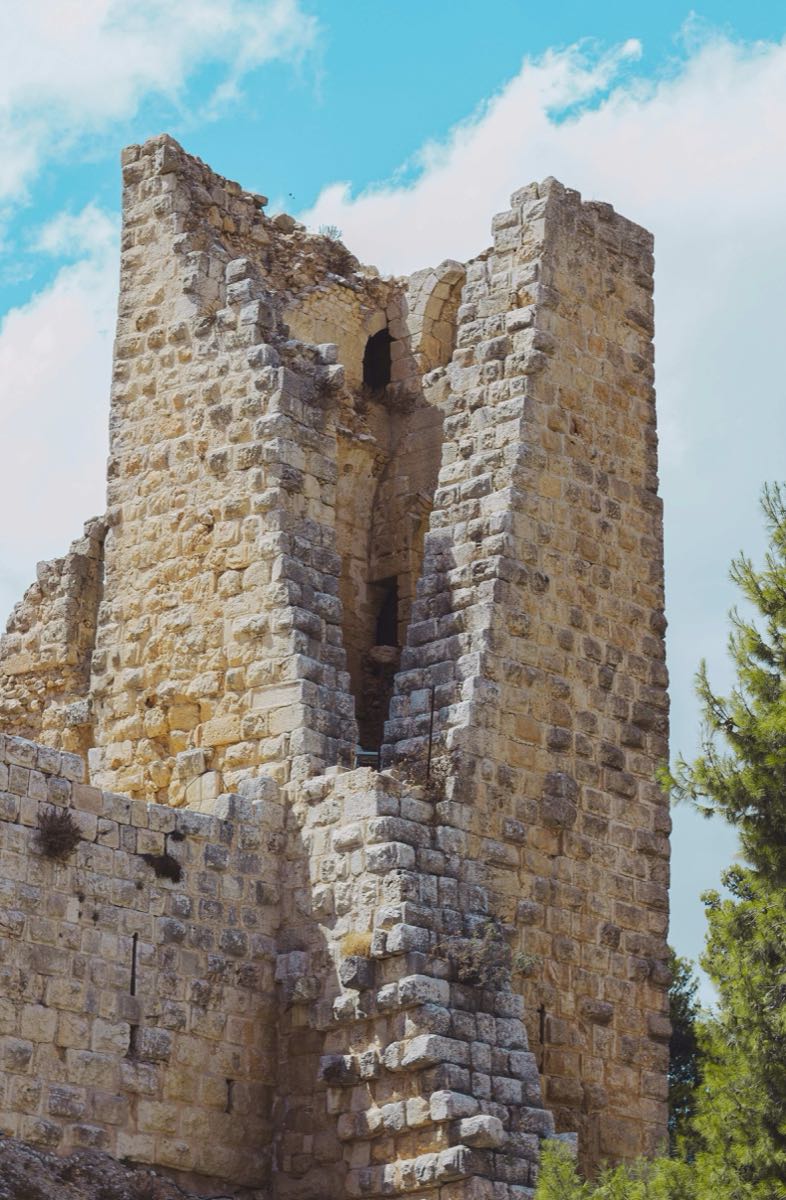
Ajloun sits in the forested hills of northern Jordan, roughly midway between Amman and the Syrian border. Most visitors come for two things: a 12th-century Arab castle that dominates the ridge above town, and the RSCN-managed forest reserve that spreads across the surrounding hills. Combine the two in a single day and you cover both without rushing.
The town itself is quiet and functional rather than tourist-oriented, which means lower prices, no crowds at the castle, and the chance to buy olive oil direct from local producers at the Friday market.
Ajloun Castle (Qal’at ar-Rabad)
Built between 1184 and 1185 by Izz al-Din Usama - a general serving under Saladin - Ajloun Castle was constructed primarily as a counter to the chain of Crusader fortresses that ran along the Jordan River valley. Its position on a 1,250-metre ridge gave it commanding lines of sight to Belvoir Castle in what is now Israel, and signal fires could relay messages across the network within hours.
The castle was expanded several times after its initial construction and served as an administrative centre under the Mamluks in the 13th century. An earthquake caused significant damage in 1927 and restoration work continues - sections are occasionally closed while scaffolding is in place.
Entry costs approximately JOD 3 as of 2026. Hours are 08:00–17:00 daily, extended to 18:00 during summer. The upper tower offers unobstructed views over the Jordan Valley; on clear winter mornings the Sea of Galilee is visible to the northwest.
Allow 45–60 minutes to walk the main rooms, cross the restored drawbridge, and climb to the top tower. There is a small café near the entrance selling tea and snacks. Parking is free on the road below the castle entrance.
Ajloun Forest Reserve
The RSCN (Royal Society for the Conservation of Nature) manages 13 square kilometres of deciduous forest on the hillsides around Ajloun - one of the few remaining stretches of oak, pine, carob, and wild strawberry trees in the Levant. The reserve was established in 1988 and has since become a model for community-based ecotourism in Jordan.
Entry to the reserve costs approximately JOD 2. The visitor centre (open daily 08:00–17:00) provides trail maps, sells local products, and arranges guided hikes.
Three marked trails suit different fitness levels:
Roe Trail (2.5 km, easy, year-round): The shortest option, designed to be completed without a guide. It passes through open woodland and circles back to the visitor centre in under an hour. Good for families with children or anyone short on time.
Soap House Trail (5 km, moderate, best in spring and autumn): Passes the traditional soap-making cooperative in the village of Rasoun, where local women produce olive oil soap using methods unchanged for generations. Allow 2–2.5 hours. A guide (approximately JOD 15–20) adds context to both the ecology and the soap-making process.
Orjan Trail (6 km, moderate): Drops down into the Orjan Valley and climbs back up through terraced farmland. The most varied terrain of the three. Plan 2.5–3 hours. Spring (March–May) is the best season - wildflowers are dense and temperatures stay cool.
The reserve also has fixed chalets available for overnight stays, bookable through the RSCN website. Staying overnight lets you walk the trails at dawn, when the forest is at its quietest.
Ajloun Town and Local Olive Oil
Ajloun’s surrounding hillsides are planted with olive groves - the area produces some of northern Jordan’s best extra-virgin olive oil. The weekly Friday market in town is the most direct way to buy from local producers; prices are significantly lower than Amman’s supermarkets and the oil is typically from the most recent harvest.
The town has several simple restaurants along the main street serving grilled chicken, mansaf, and falafel. None is upscale, but the food is honest and inexpensive. There is no reason to travel to Ajloun for the restaurants specifically, but you will eat well enough if you are spending the day.
Combining Ajloun with Jerash
Jerash, 20 km south of Ajloun, is one of the best-preserved Roman cities in the Middle East - most day-trip itineraries from Amman combine both sites. The standard sequence is to arrive at Jerash when it opens (08:00), spend 2–3 hours there, then drive north to Ajloun for the castle and a forest walk in the afternoon.
If you are using public transport, minibuses connect Jerash and Ajloun directly (approximately JOD 0.5, 30 minutes). Confirm at the Jerash bus stand that the service is running - frequency drops in the afternoon. To book a guided Jerash and Ajloun day tour from Amman, browse northern Jordan tours.
Book a Tour to Ajloun
| Tour | Duration | From | Book |
|---|---|---|---|
| Jerash + Ajloun Castle Full-Day from Amman (transport + guide) | 8 hrs | $50/person | Book → |
| All northern Jordan tours | - | - | Browse on GYG |
Prices verified from TripAdvisor / GetYourGuide as of 2026. Ajloun Castle entry (approx JOD 3) and Jerash entry (approx JOD 10) are typically separate; confirm inclusions when booking.
Getting to Ajloun from Amman
Ajloun is 76 km northwest of Amman, around 1.5 hours by road.
Minibus: From Amman’s North Bus Station (Abdali), minibuses run to Ajloun town roughly every 30–45 minutes throughout the morning. The fare is approximately JOD 1.5–2 per person. Services thin out after 14:00, so plan your return accordingly.
Private taxi or car hire: A private taxi from central Amman costs approximately JOD 25–35 one-way. If you are combining Ajloun and Jerash, hiring a driver for the full day (approximately JOD 60–80 depending on negotiation) is the most flexible option and avoids the return timing problem.
Driving: Park near the castle on the approach road. The RSCN visitor centre has its own car park a few kilometres outside town on the Ajloun–Irbid road - look for the RSCN signs.
Search hotels in Ajloun on Booking.com