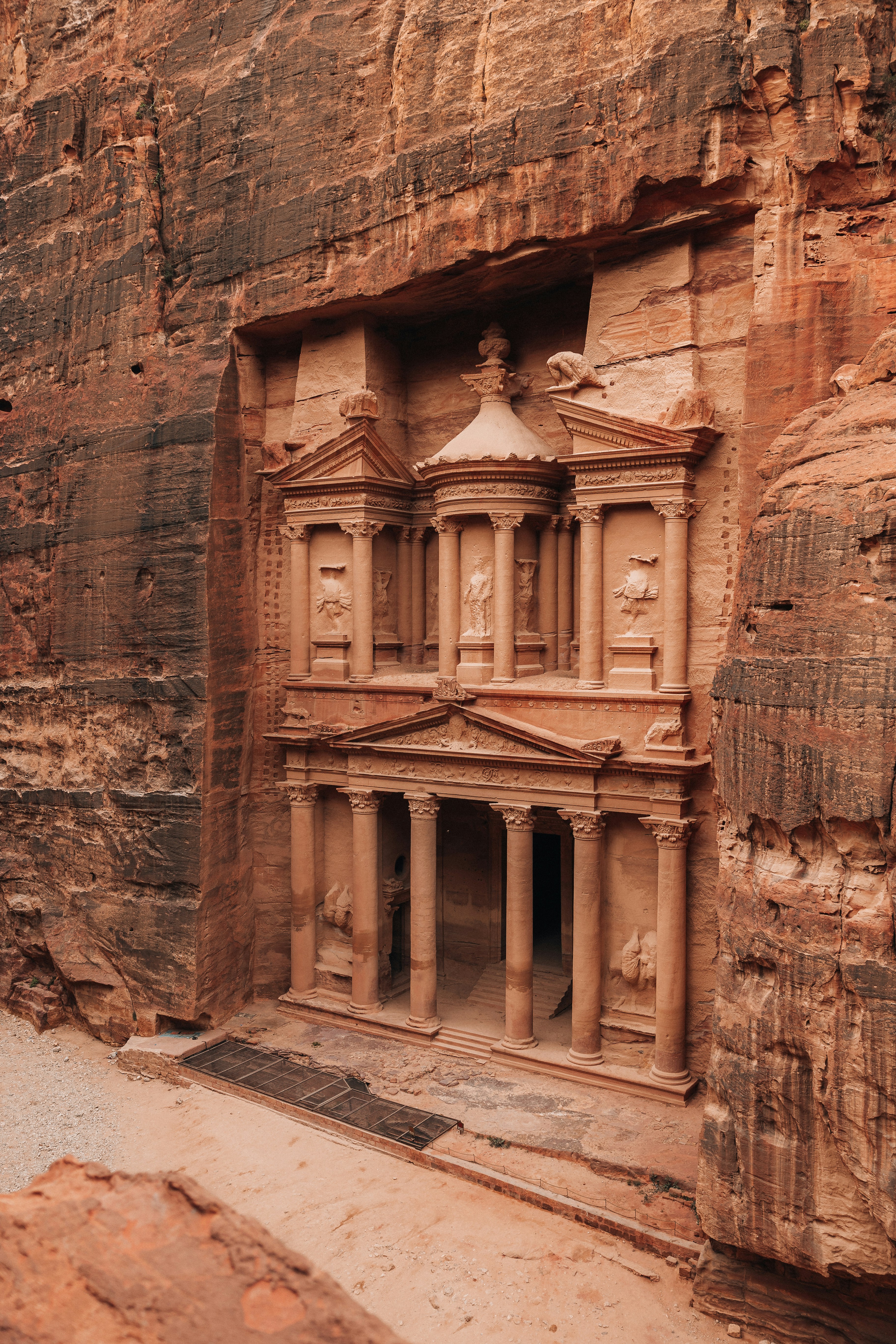
Petra is most often described by the colour of its rock - the rose-red, amber, and cream of the sandstone cliffs that form its walls, tombs, and facades. The description is accurate but misses what makes the site genuinely remarkable: that a people with no prior tradition of monumental stone architecture arrived in this dry valley, carved an entire city into the cliff faces, engineered one of the ancient world’s most sophisticated water management systems, and controlled an empire of trade routes stretching from the Arabian Peninsula to the Mediterranean. They did this in less than four centuries.
The Nabataean People and Their Origins
The Nabataean Arabs appear in written records from the 4th century BCE, when a Greek general - Hieronymus of Cardia - described them as a nomadic people inhabiting the rocky terrain south of the Dead Sea. His account was not flattering: he noted that they moved camp constantly, drank no wine, and resisted any attempt at permanent settlement.
Within a century, those same people had built Petra.
The transformation is explained by trade. The Nabataeans controlled the overland routes along which frankincense, myrrh, and spices moved northward from southern Arabia (modern Yemen and Oman) to the Mediterranean ports and markets of Egypt, Syria, and Rome. These were not minor commodities. Frankincense was essential for religious ritual across the entire ancient Mediterranean world; myrrh was used in medicine, cosmetics, and embalming at a scale and price that made it among the most valuable substances of the era. The Nabataeans sat at the bottleneck of this trade and collected tolls accordingly.
Petra’s position in the Wadi Musa - a valley surrounded by cliffs that made it defensible and near enough to springs to sustain a city - was chosen with deliberate precision. Caravan routes from Arabia, Gaza, Damascus, and the Red Sea coast converged here. Control Petra and you effectively controlled the flow of luxury goods from east to west.
The Architecture of a Trading Empire
What distinguishes Nabataean Petra from other ancient cities is the almost total absence of conventional construction. The Nabataeans did not build Petra - they carved it. The facades of tombs, temples, and public buildings were cut directly into the sandstone cliff faces, leaving the rock interior hollowed into chambers.
The style reflects the Nabataeans’ unusual cultural position. Facing the Mediterranean world at the height of Hellenistic influence, they adopted Greek architectural vocabulary - pediments, Doric columns, classical friezes - and applied it to something no Greek city ever attempted: cutting those forms into vertical rock faces at scales that remain dramatic even by modern standards. The Treasury (Al-Khazneh) stands 43 metres tall. The Royal Tombs along the eastern cliff face were carved to visible proportions from the valley floor, serving a function partly architectural and partly political: these were statements of power carved into the landscape itself.
The Treasury is the most photographed structure in Jordan and among the most recognisable monuments in the world. Despite the name - which originated with Bedouin stories of hidden Egyptian gold inside the carved urn - it almost certainly served as a royal tomb. The lower storey dates from the reign of Aretas III (87–62 BCE); the upper storey was completed later. The interior is simple: three chambers with no decoration, consistent with funerary rather than storage use.
Beyond the Siq entrance canyon, the city opens into a broader valley containing the Colonnaded Street, the Nymphaeum, the Great Temple (one of the few free-standing Nabataean structures rather than carved facades), and the Monastery (Ad Deir) - a facade even larger than the Treasury, reached by climbing more than 800 steps cut into the rock.
Hydraulic Engineering
The engineering achievement that made Petra viable as a city of perhaps 20,000–30,000 people in an arid environment was not the carved facades - it was the water system.
Petra sits in a desert valley that receives perhaps 100mm of rainfall per year. Flash floods threaten the Siq during storm events. The Nabataeans solved both problems simultaneously: they built a system of dams, channels, cisterns, and terracotta pipes that collected flash flood water, filtered and stored it, and distributed it through the city. Cisterns carved into the rock were identified at hundreds of points throughout the site during 20th-century archaeological surveys. The pipes that delivered water to public fountains and private buildings were fired ceramic - a sophisticated manufactured product, not improvised clay channels.
This system sustained the city through the dry months when caravan traffic was highest and water demand peaked.
King Aretas IV and the Peak of Nabataean Power
The reign of Aretas IV Philodemos (9 BCE–40 CE) marks the zenith of Nabataean power and the period when much of what survives at Petra was constructed or significantly expanded. Aretas IV appears on coins minted throughout the region and is mentioned in the New Testament (2 Corinthians 11:32) as the king whose governor guarded Damascus - a detail indicating the extent of Nabataean reach northward.
Under Aretas IV, Petra’s population was at its maximum, the trade network was at peak function, and the architectural programme was most active. The city contained a theatre (carved into the rock, capacity 3,000–4,000), a colonnaded main street, temples, markets, baths, and suburbs extending well beyond the main valley.
Roman Annexation (106 CE)
In 106 CE, the Roman Emperor Trajan annexed the Nabataean kingdom without military resistance. The last Nabataean king, Rabbel II, had died the previous year, and the kingdom passed to Rome through what appears to have been a negotiated transfer rather than conquest. The territory became the Roman province of Arabia Petraea.
Roman rule changed Petra’s status but did not immediately end its prosperity. The Romans built additional public monuments, and the colonnaded street was reorganised on Roman urban planning principles. However, the establishment of direct Roman control of the trade routes - and later the shift of commercial traffic to sea routes via the Red Sea - gradually reduced Petra’s economic centrality. By the 3rd century CE, Petra was no longer the Nabataean capital but a significant Roman provincial city.
Byzantine Period and Christian Petra
Christianity reached Petra during the 4th century, and the city became a bishop’s see. Several of the Nabataean tombs and temples were converted into churches. The most significant Byzantine-era discovery was made in 1993, when a wildfire at the Petra Church - a Byzantine structure built into an earlier Nabataean building - led to the uncovering of 140 papyrus documents from the 6th century CE. These Petra Papyri, now held at the American Center of Oriental Research in Amman, provide detailed records of land transactions, family disputes, and economic life in late antique Petra - a remarkable primary source for a period otherwise poorly documented.
The earthquake of 363 CE caused severe damage to Petra’s water infrastructure and public buildings. The city contracted significantly but was not immediately abandoned. A further earthquake in 749 CE ended any remaining permanent settlement of the main valley.
Crusader Occupation and Rediscovery
Crusader forces briefly occupied the Petra region in the 12th century, constructing a small fortress on al-Habis hill overlooking the main valley. This occupation lasted only decades before Saladin’s forces retook the territory.
After the Crusader period, Petra faded from European geographical knowledge entirely. The Bedouin of the surrounding region - primarily the Bdul tribe, whose members lived in the Petra caves until the 1980s - maintained continuous knowledge of the site, but it was absent from Western cartography.
Johann Ludwig Burckhardt, a Swiss explorer travelling the region in disguise as an Arab pilgrim named Ibrahim ibn Abdallah, persuaded his guide to take him to the site on 22 August 1812, on the pretext of wishing to sacrifice a goat at the tomb of Aaron on nearby Jabal Haroun. His published account of the visit - he could not take extensive notes openly without revealing his identity - introduced Petra to European audiences for the first time in centuries.
Archaeological work began in the 1920s and has continued since. UNESCO inscribed Petra as a World Heritage Site in 1985.
Visiting Petra Today
Entry to Petra costs approximately JOD 50 for a one-day pass (as of 2026). The Jordan Pass covers admission and is worth purchasing if you are also visiting Jerash and other paid sites - the three-day pass costs JOD 80 and includes three days of Petra entry along with admission to over 40 other sites. The site is open daily from 6am to 6pm (winter closing is somewhat earlier - check current hours). The main entrance is at the Petra Visitor Centre in Wadi Musa town. Horses carry visitors to the Siq entrance for an additional fee (around JOD 10 return, negotiable). The walk from the visitor centre through the Siq to the Treasury takes about 25 minutes at a moderate pace.
Allow a full day minimum for the main circuit. The Monastery requires a further two to three hours from the Treasury and is worth the effort - the site sees fewer visitors than the lower valley. Guided tours that cover the Nabataean context in depth are available through Petra tour operators.