Petra Travel Guide: The Rose-Red City of the Nabataeans
Plan your visit to Petra: entry fees, the Siq, Treasury, Monastery, Petra by Night, where to stay nearby, and how to get there from Amman.
Guides for Petra
Petra was the capital of the Nabataean Kingdom from around the 4th century BC until Roman annexation in 106 AD. The Nabataeans were desert traders who controlled the incense routes connecting Arabia, Egypt, and the Mediterranean, and they spent their wealth carving an entire city from the rose-coloured sandstone of the Wadi Musa valley. At its peak, Petra may have housed 30,000 people. By the Byzantine period it was largely abandoned. It was not widely known in the Western world until Johann Ludwig Burckhardt visited in 1812, disguised as a pilgrim.
Today it is Jordan’s most visited site and one of the most recognised archaeological landscapes on earth. The scale of it - both physically and historically - consistently surprises first-time visitors regardless of how many photographs they have seen beforehand.
Entry Fees and the Jordan Pass
Petra admission as of 2026:
| Ticket | Price |
|---|---|
| 1-day entry | JOD 50 |
| 2-day entry | JOD 55 |
| 3-day entry | JOD 60 |
The Jordan Pass covers all Petra entry tiers (visit duration chosen at purchase) plus the Jordanian visa fee for most nationalities. Purchase at jordanpass.jo before you travel. If you are visiting from a country that requires a visa and plan to spend at least two nights in Jordan, the Pass typically pays for itself.
The site opens daily at 06:00 and the last entry is at 16:00, though you can stay inside until dusk. There is no photography fee.
The Siq
The approach to Petra runs for 1.2 km through the Siq - a natural gorge where the sandstone walls narrow to as little as three metres in places and rise to over 80 metres. The walk takes 20–30 minutes at a steady pace. Look for sections of original Nabataean paving, the remains of a ceremonial arch at the entrance, and the carved water channels that line both walls - evidence of the sophisticated hydraulic engineering that let Petra support a large population in an arid environment.
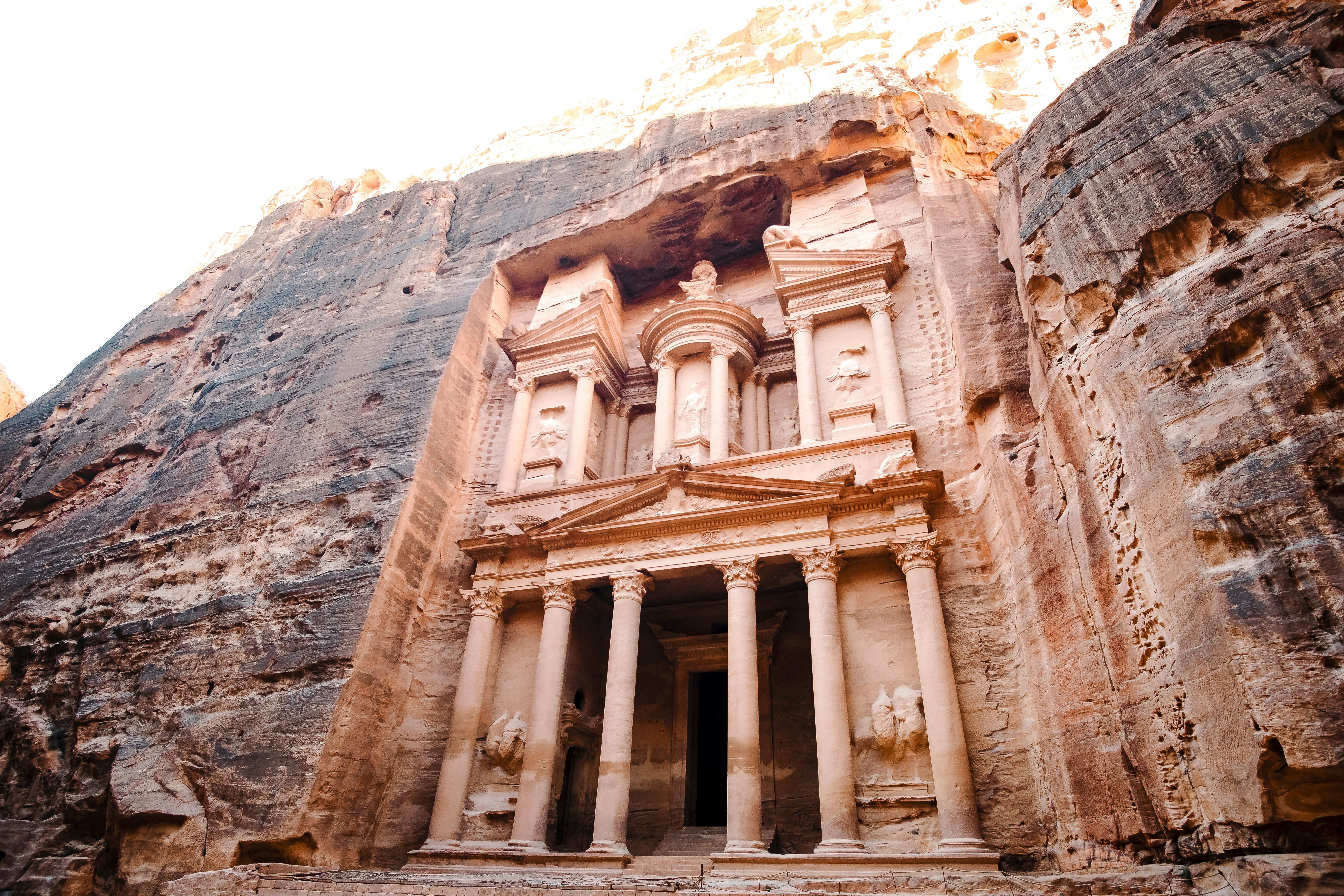
The gorge bends and the Treasury appears without warning. This is one of the most effective reveals in architecture anywhere in the world.
The Treasury (Al-Khazneh)
The Treasury facade stands approximately 40 metres wide and 43 metres tall, carved directly into the cliff face. It served as a royal tomb - almost certainly for the Nabataean king Aretas IV - not as a treasury, despite the name. The urn at the top of the upper pediment was believed by local Bedouin to contain hidden gold, which is why it is pockmarked with bullet holes.
You cannot enter the interior, which is a single undecorated chamber, but the facade itself holds most of the interest. Horses and camel rides are offered in the plaza; the animals work in difficult conditions and the decision whether to use them is a personal one.
Street of Facades and the Theatre
Walking south from the Treasury along the Outer Siq, you pass the Street of Facades - a continuous row of Nabataean tomb fronts carved into the cliff. Most date from the 1st century AD. Further along, the Nabataean Theatre has been partly reconstructed and seated roughly 8,500 people in its Roman-period configuration. Entry to the site beyond this point is included in the main ticket.
Royal Tombs
The four Royal Tombs cut into the cliff face above the Colonnaded Street are among the most elaborate structures in Petra. The Urn Tomb, the Silk Tomb, the Corinthian Tomb, and the Palace Tomb differ considerably in their preservation and decoration. The Urn Tomb is the most accessible and was later converted into a Byzantine church - you can still see the apse carved into the original tomb chamber.
Colonnaded Street and Qasr al-Bint
The Colonnaded Street marks what was once Petra’s main commercial thoroughfare, flanked by column bases and the remains of market stalls. At the far end stands Qasr al-Bint - the Great Temple of the Nabataeans and one of the few freestanding structures in Petra rather than a carved facade. Dedicated to the Nabataean deity Dushara, it dates from around the 1st century BC. Entry is included in the main site ticket.
The Monastery (Ad-Deir)
The Monastery is larger than the Treasury - the facade measures roughly 45 metres wide and 50 metres high - but requires a climb of approximately 850 rock-cut steps from the main valley floor. The hike takes 45–60 minutes each way and gains around 200 metres of elevation. The path is clear and well-travelled; donkeys and horses are available for hire at the foot of the trail, typically for approximately JOD 10–20 each way.
Start the climb by 08:00 if you want the Monastery mostly to yourself, or by 14:00 to arrive in the late afternoon light. A small tea stall at the top sells cold drinks and snacks.
Petra by Night
The Petra by Night experience runs on Monday, Wednesday, and Thursday evenings, starting at approximately 20:30 (confirm current times at the visitor centre). Candles line the Siq, the Treasury plaza is illuminated, and a short Bedouin music performance is given. Tickets cost approximately JOD 17 per person as of 2026 and are separate from daytime entry. Practical note: the candlelit Siq is atmospheric but dim; wear shoes with grip and carry a small torch.
Where to Stay in Petra
Mövenpick Resort Petra - The most convenient upmarket option: the entrance gate is literally a two-minute walk from the lobby. Rooms are well appointed and the buffet dinner is useful after a long day on the trail. Rates run approximately JOD 120–200 per night as of 2026. Book well ahead during spring and autumn peak seasons.
Rocky Mountain Hotel - A reliable mid-range choice in Wadi Musa town, around 10 minutes’ walk from the entrance. The rooftop restaurant has views across the valley. Rates from approximately JOD 35–55 per night as of 2026. Breakfast is included in most rates.
Seven Wonders Hotel - Also in Wadi Musa, with straightforward rooms and a helpful owner who can arrange taxis and guides. Rates from approximately JOD 45–70 per night as of 2026. Good value for the location.
For a more detailed comparison - including camp options inside the protected area and tips on which properties are closest to the entrance - see the where to stay in Petra guide.
Search hotels in Petra on Booking.com
Where to Eat Near Petra
Al Arabi Restaurant - A no-frills local restaurant in Wadi Musa town serving grilled meats, rice dishes, and mezze. Popular with Jordanian day-trippers as well as tourists. Expect to pay approximately JOD 8–15 per person as of 2026.
Petra Kitchen - Offers an evening cooking class where small groups prepare a traditional Jordanian meal and then eat it together. A good way to break up an itinerary dominated by walking. Cost approximately JOD 35 per person as of 2026, including the meal. Booking in advance is recommended; capacity is limited.
Getting to Petra from Amman
JETT Bus - The most reliable public transport option. Buses depart from the Abdali bus station (sometimes called Tabarbour in newer listings - confirm when booking) in Amman, typically once daily at 06:30. The fare is approximately JOD 5 one-way. Journey time is 3–3.5 hours depending on stops. Return services typically depart Petra (Wadi Musa) at 17:00. Check current schedules at jett.com.jo.
Private taxi - A private taxi from Amman to Petra costs approximately JOD 60–80 one-way and can be arranged through your hotel. The advantage is flexibility on departure time. For groups of three or four, it can work out close to the bus fare per person.
Rental car - The Desert Highway (Highway 15) is straightforward and well-signed. Driving time from Amman is around 2.5–3 hours. Parking is available near the Petra visitor centre. Hire a car from Amman airport and you can stop at the King’s Highway sites (Madaba, Kerak, Dana) en route without being locked into a tour schedule. To book a guided Petra tour from Amman or a Petra–Wadi Rum combo, browse Petra tours and packages - or check last-minute tours in Jordan if you’re booking on short notice.
When to Visit Petra
March and April are Petra’s most popular months - wildflowers are out in the surrounding highlands and the weather is ideal for long days on the trails. April in particular fills the Mövenpick and the better guesthouses weeks ahead. October and November offer similar temperatures with far fewer visitors and noticeably lower hotel rates. These four months are the best windows for a first visit.
May is the last month before heat becomes a serious constraint; the Monastery hike is manageable if you start by 07:00. September is the first comfortable autumn month, though early September can still reach 32°C in the valley by midday. July and August require disciplined early starts (at the Siq by 06:00) and afternoons at your hotel or in Wadi Musa town.
More in Petra
- Things to Do in Petra
- Getting Around Petra
- Day Trips from Petra
- Food to Try Near Petra
- Best Hotels in Petra
- Petra History: The Nabataean City
- Petra by Night Experience
- Petra Tours: Guided Options
- 3-Day Petra and Wadi Rum Itinerary
- Petra vs Wadi Rum: Which to Visit First?
- Jordan Pass Guide
Want a guide for the site? See our best tours in Petra for day trips, guided walks and small-group options.
Book an experience
Top experiences in Petra
Explore the best tours and activities in Petra , with instant confirmation and free cancellation on most bookings.
Frequently Asked Questions
- How many days do you need to see Petra properly?
- One day covers the main trail - Siq, Treasury, Street of Facades, Theatre, Royal Tombs, and Colonnaded Street. Two days lets you add the Monastery (Ad-Deir) without rushing and allows time for the quieter northern trails. If you have a multi-day ticket, three days opens up Little Petra and the High Place of Sacrifice trail.
- Is Petra included in the Jordan Pass?
- Yes. The Jordan Pass bundles the Petra entry fee with a Jordanian visa (for eligible nationalities) and 40+ other attractions. It is worth buying if you plan to stay more than two nights in Jordan, as the pass price roughly equals the visa fee plus a one-day Petra ticket.
- What is the best time of day to visit the Treasury?
- Arrive at the Siq entrance before 07:00 to reach the Treasury before the bulk of organised tour groups. The light on the facade is best in the morning. By 10:00 it is significantly more crowded. Going late afternoon (after 15:00) is the second-best option as day-tripper groups begin to leave.
- Is Petra by Night worth it?
- Petra by Night runs on Monday, Wednesday, and Thursday evenings (approximately 20:30–22:30). The Siq and Treasury are lit by around 1,500 candles and you sit for a short musical performance. It is atmospheric rather than informative. The ticket costs approximately JOD 17 as of 2026 and does not include daytime entry.