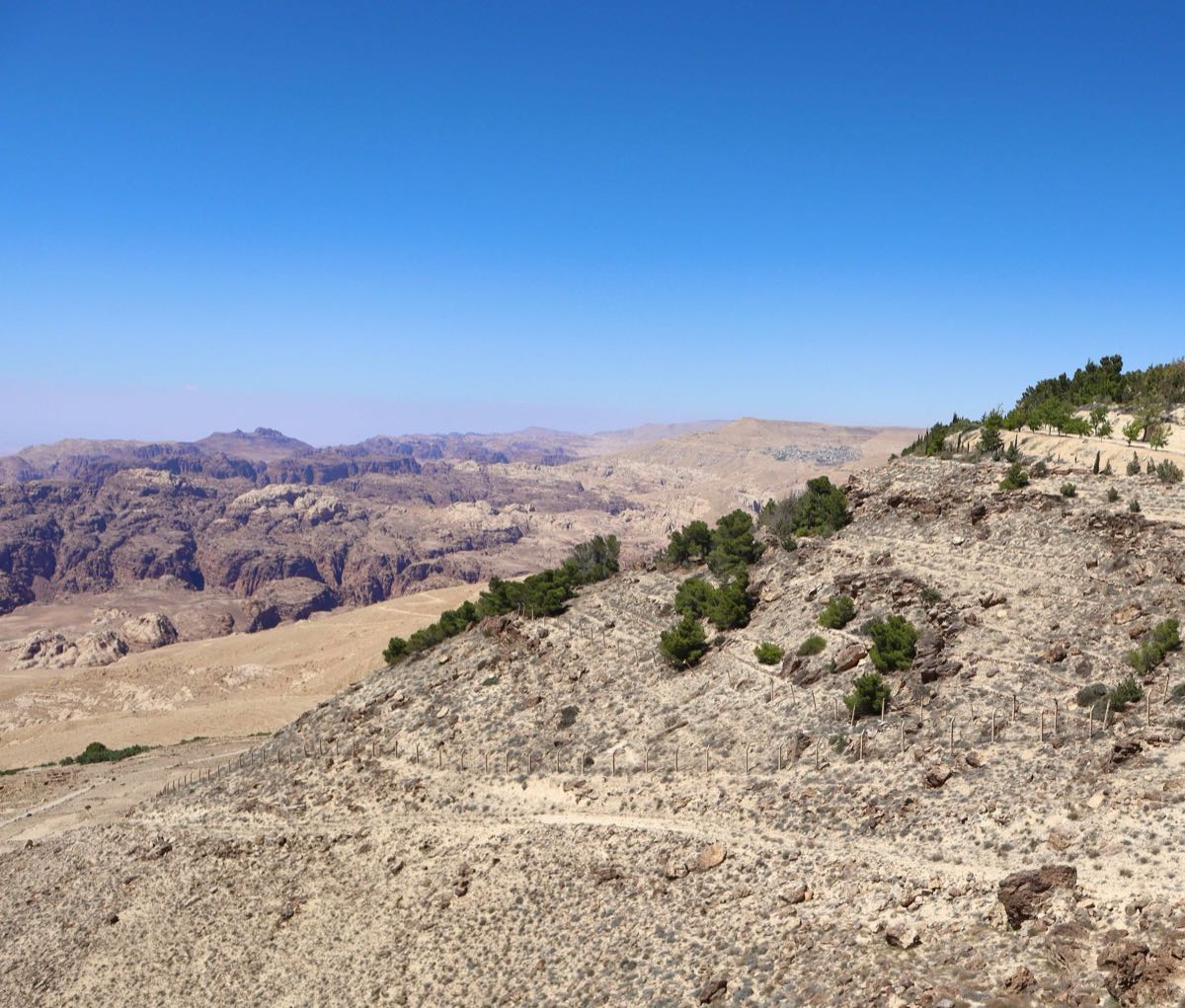
Mount Nebo - the summit ridge of Siyagha, rising to 817 metres above sea level - is one of the most significant biblical sites in Jordan. This is where Moses is said to have stood and looked across to the Promised Land before his death, a scene described in Deuteronomy 34. Whether or not you have a particular interest in religious history, the combination of the viewpoint, the Byzantine mosaics, and the memorial church makes it a genuinely worthwhile hour or two.
Most visitors approach Mount Nebo as part of a day circuit from Amman, combining it with Madaba (10 km east), and sometimes the Dead Sea (35 km west). The three sites sit along a single road and work well as a half-day or full-day itinerary.
The Moses Memorial Church
The Moses Memorial Church of Mount Nebo stands on the highest point of the Siyagha ridge and has been managed by the Franciscan Custody of the Holy Land since 1933. The original church dates to the late 4th century, though most of what survives today - particularly the mosaics - is from 5th- and 6th-century expansion and renovation work.
Entry to the entire site costs approximately JOD 3 as of 2026. Opening hours are 08:00–18:00 daily in summer (approximately May–September) and 08:00–17:00 in winter. The site is generally well managed - paths are paved, signage is clear in English and Arabic, and there is a small gift shop near the entrance.
The church interior is the primary draw. The floor mosaics, largely intact and protected under a modern roof structure, are among the best-preserved examples of Byzantine religious art in the Levant. The most famous is a hunting and herding scene from 531 CE, showing stylised animals, trees, and human figures in the geometric register typical of the period. A separate mosaic map panel references key pilgrimage sites of the early Christian world. Photography inside the church is permitted.
Allow 30–45 minutes inside the church and another 15–20 minutes for the viewing terrace and the sculpture outside.
The Serpentine Cross Sculpture
Outside the church, on the edge of the viewing terrace, stands a large bronze sculpture of intertwined serpent and cross - the work of Italian artist Giovanni Fantoni, installed in 1984. The design fuses two biblical symbols: the bronze serpent Moses raised in the wilderness (Numbers 21:8–9) and the cross of Christ. It has become one of the most photographed objects in Jordan, appearing on postcards and in travel photography at a rate disproportionate to its modest scale.
The sculpture functions primarily as a foreground for the view behind it, and on clear days the composition of cross against the Jordan Valley is genuinely striking.
The Viewpoint
The viewing platform at Mount Nebo is equipped with a large orientation board identifying what you are looking at across the valley. On a clear day the following are visible:
- The Jordan River valley below (the river itself is a narrow strip of green difficult to pick out from this distance)
- The northern end of the Dead Sea, approximately 40 km southwest
- The hills of Judea and Samaria beyond the Dead Sea
- On very clear winter days, the city of Jerusalem is visible as a cluster of buildings on the Judean ridge, approximately 50 km northwest
Summer visibility is frequently poor due to heat haze. Winter mornings - particularly January and February - offer the best conditions. Arriving early (around 08:00–09:00) is recommended regardless of season, as tour buses tend to arrive mid-morning and the terrace becomes crowded.
Moses’ Spring (Ayoun Musa)
Five kilometres north of Mount Nebo, on the road descending toward the Jordan Valley, is Ayoun Musa - the Springs of Moses. The site is associated with the water Moses is said to have drawn from the rock during the Exodus wanderings. It is not a major archaeological site, but the setting - a small grove of trees fed by natural springs - is pleasantly cool and quiet.
There is no entry fee. The springs are most easily visited en route between Mount Nebo and the Dead Sea, making them a logical quick stop if you are doing the full day circuit. A small rest area allows you to pull off the road; look for the sign approximately 3 km after descending from the Nebo plateau.
Combining Mount Nebo with Madaba and the Dead Sea
Mount Nebo works best as one stop in a longer day. The standard itinerary from Amman runs:
Madaba (10 km east of Mount Nebo): The St. George’s Church mosaic map - a 6th-century Byzantine floor mosaic showing the Holy Land in extraordinary detail - is one of the finest in the region and takes about 30 minutes. The town has several good lunch restaurants. Haret Jdoudna, a restored Ottoman courtyard complex near the church, serves reliable Jordanian food and is tourist-friendly without being overpriced - expect JOD 8–15 per person for a full meal.
Mount Nebo: 20–30 minutes from Madaba by taxi or car. Allow 1–1.5 hours on site.
Dead Sea: 35 km west of Mount Nebo (45 minutes by road). Public beaches are limited on the Jordanian side - most visitors pay to use a resort. The Amman Beach public resort charges approximately JOD 20–25 per person including sunbed and facilities. More upmarket resorts (Kempinski, Marriott) charge JOD 40–70+ for day access.
Getting to Mount Nebo from Amman
Mount Nebo is approximately 35 km southwest of Amman, just over an hour by road. There is no direct public bus to the site.
From Amman via Madaba: Take a service taxi or minibus from Amman’s South Bus Station (Wihdat) to Madaba - approximately JOD 0.5–1, 45 minutes. From Madaba, hire a local taxi for a return trip to Mount Nebo including 30–45 minutes of waiting time; negotiate approximately JOD 10–15 for this.
Private taxi from Amman: A direct private taxi from central Amman to Mount Nebo costs approximately JOD 20–30 one way. If you are doing the full Madaba–Nebo–Dead Sea circuit, hire a driver for the day (approximately JOD 60–80) rather than piecing together separate taxis - the Dead Sea is in the opposite direction and individual fares add up quickly.
Guided tour from Amman: Several operators run combined Madaba, Mount Nebo, and Dead Sea day tours from Amman for approximately USD 40–70 per person including transport and guide. This is the most straightforward option for first-time visitors who want context alongside the sites.
Driving (hire a car): Take the Desert Highway (Highway 15) southwest from Amman toward Madaba, then follow signs to Mount Nebo. Parking at the site is free. To join a guided day tour from Amman that covers Mount Nebo, Madaba, and the Dead Sea, browse Jordan day tours.
Search hotels in Mount Nebo on Booking.com