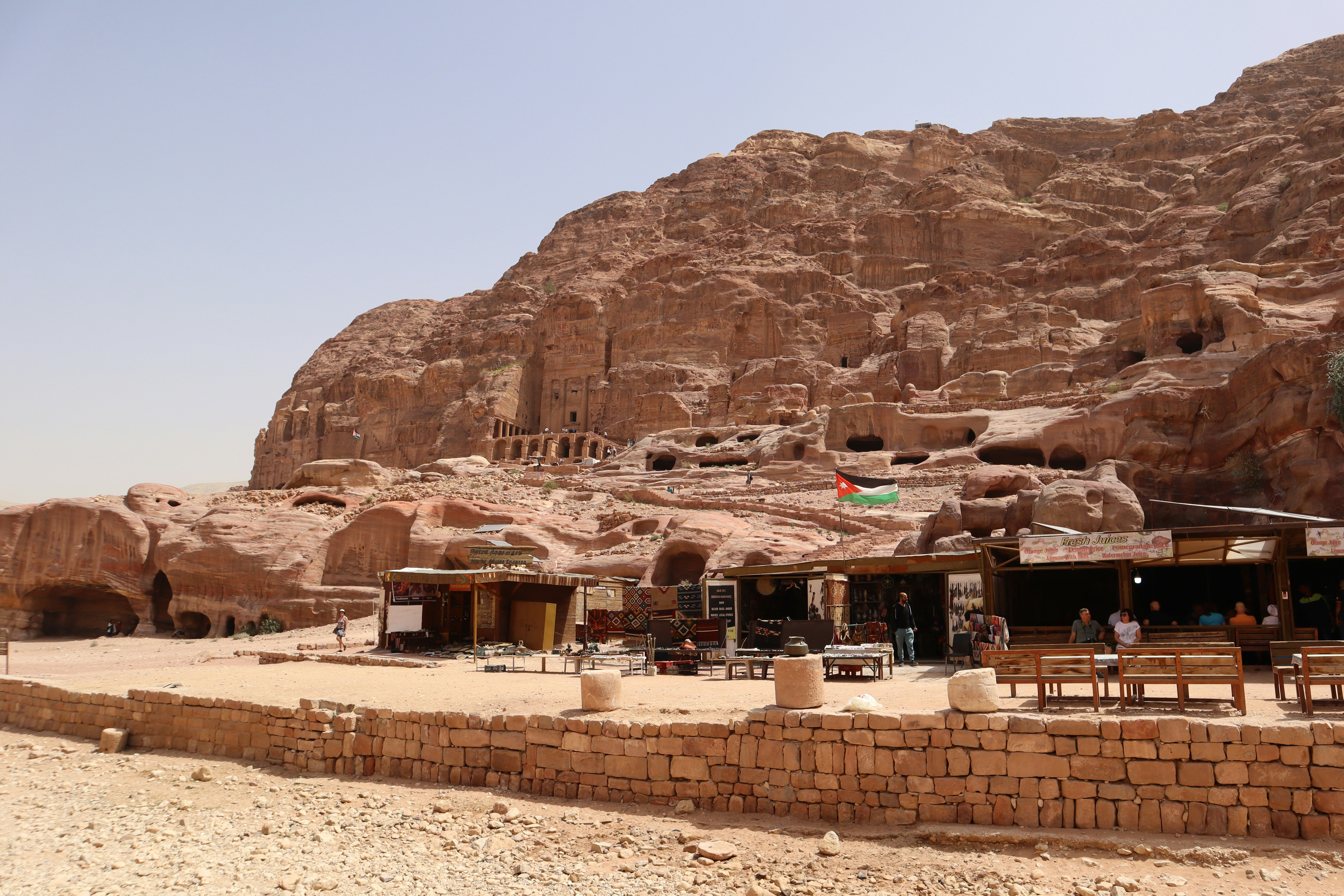
Wadi Musa is the town that serves Petra - a functional place built almost entirely around the archaeology site rather than any independent identity. Most visitors arrive, walk Petra for one or two days, and leave, meaning the restaurants here exist primarily to feed people who are tired, hot, and short on decision-making energy. The good news is that the town has a broader range than this framing suggests, with several genuinely good local restaurants, a few places that rise above the tourist-circuit average, and the option to eat inside the site itself.
Inside Petra: The Basin Restaurant
The Basin Restaurant sits at the far end of the main archaeological route, near the Colonnaded Street and the Qasr al-Bint temple. It is managed as part of the Petra site and offers a buffet lunch that functions primarily as fuel for the long walk back to the entrance. The spread includes standard Jordanian dishes - rice, grilled chicken, lamb, mezze, vegetables - at a fixed cost of approximately JOD 12–15 per person as of 2026. The quality is adequate rather than memorable, but the setting is inside the ancient city and the prices are reasonable for what is effectively a captive-audience restaurant.
Most people who eat here are in the third or fourth hour of a visit and have another hour of walking ahead. A substantial meal slows the return journey; the lighter options from the buffet - a plate of mezze, bread, salad - are a more sensible choice.
The Site Entrance Area
Just outside the Petra Visitor Centre, several cafes and stalls operate for the pre-entry crowd. Al-Arabi Restaurant, near the main entrance, is the most frequently mentioned local option. It opens early, serves a full Jordanian breakfast from approximately 07:00, and is busy with Jordanian guides and drivers who work the site. Breakfast costs approximately JOD 3–5 per person; lunch dishes of chicken, rice, and salad run JOD 4–7.
Wadi Musa Town: Local Restaurants
The town of Wadi Musa climbs a hill above the Petra entrance and becomes more locally oriented as you move away from the tourist core.
Al-Wadi Restaurant is a sit-down establishment in the centre of town favoured by local families and guides. The menu covers standard Jordanian cooking - mansaf (lamb over rice in dried yoghurt sauce), grilled chicken, hummus, and seasonal dishes. A full meal costs approximately JOD 5–9 per person as of 2026. It is not a tourist-facing operation; the food reflects what local Jordanians actually eat rather than what they imagine tourists want.
Cleopetra Restaurant is better known in Wadi Musa among travellers than many listings suggest - it is one of the more consistent mid-range options in town, with a terrace and a slightly broader menu that includes pasta and sandwiches alongside the Jordanian standards. A meal runs approximately JOD 6–12 per person.
Saba Restaurant operates near the tourist accommodation belt and is an honest mid-range option. Grilled meats are well-executed; the mixed grill plate with salad and bread at approximately JOD 8–12 per person is the strongest order.
Tourist Restaurants vs Local Spots
The practical distinction in Wadi Musa is straightforward. Tourist-oriented restaurants are clustered near the main road through town, near the larger hotels, and at the Petra entrance. They will have English-language menus, sometimes photographs of dishes, and prices that run 25–50% higher than locally-oriented places for equivalent food. The quality is often fine; the experience is interchangeable with tourist restaurants elsewhere in Jordan.
Local spots are less obviously signposted, often have no printed English menu (but staff will usually find a way to communicate), and serve better food for less money. Signs to look for: a predominantly Jordanian clientele, a TV showing football, no photographs of food on the wall, and a plastic tablecloth.
For a full list of options in the area, the hotel you’re staying at will have the most current picture - guides and hotel staff know which places are open, which have changed ownership, and which have slipped.
Cave Dining: The Petra Kitchen Concept
Several establishments in Wadi Musa have incorporated the cave aesthetic into their experience - rough stone walls, low lighting, cushioned seating - which works reasonably well given the Nabataean context. Petra Kitchen is the most structured of these: a cooking class cum dining experience where guests participate in preparing a Jordanian meal and then eat it together. The experience costs approximately JOD 30–40 per person as of 2026 and runs in the early evening. It is better suited to a first or second visit to Jordan when learning the fundamentals of Jordanian cooking has context; on a fourth or fifth visit it becomes redundant. Booking ahead is required; space is limited. For food tours and cultural experiences around Petra, browse Petra tours - several operators include a cooking or food element alongside the archaeological site visit.
For broader Jordan cooking experiences, see our Jordan cooking classes guide.
What to Eat in the Petra Region
The food of southern Jordan around Petra and Wadi Musa is substantively different from the Levantine cooking of Amman. It is heavier on lamb, more reliant on flatbread, and the cooking methods reflect Bedouin tradition.
Zarb is the signature dish of the region - lamb, chicken, or both slow-cooked in a sealed underground pit with vegetables, potatoes, and spices. The result is intensely tender, lightly smoky, and unlike anything produced in a conventional oven. Zarb is typically available in the evening and requires ordering in advance; it is a feature of Bedouin camps in Wadi Rum as well as some Petra-area restaurants.
Mansaf - Jordan’s national dish of lamb cooked in jameed (fermented dried yoghurt) sauce over rice and flatbread - is available at most local restaurants and is the correct order when dining with Jordanian company.
Mezze is less varied than in Amman but includes the basics: hummus, mutabbal, fattoush, tabbouleh, and labneh with olive oil. Bread arrives hot from a taboun oven at the better local places.
Eating Inside Little Petra
Little Petra (Siq al-Barid) has no restaurant infrastructure. Bring water and snacks if visiting independently; the site is approximately 8 kilometres north of Wadi Musa and there are no refreshment facilities at the entrance as of 2026.
Price Reference (as of 2026)
| Setting | Cost per person |
|---|---|
| Local breakfast (town cafe) | JOD 3–5 |
| Local lunch (Al-Wadi type) | JOD 5–9 |
| Mid-range tourist restaurant | JOD 8–15 |
| Basin Restaurant buffet (inside Petra) | JOD 12–15 |
| Petra Kitchen cooking class | JOD 30–40 |
| Hotel restaurant | JOD 15–30 |
Practical Notes
Water is essential at Petra regardless of season. The site recommends carrying at least 2 litres for a half-day visit in cool weather; 3–4 litres in summer. Small water stalls operate inside the site and charge approximately JOD 1–1.50 per bottle - considerably more than outside, but not unreasonable given the logistics.
Most restaurants in Wadi Musa are open daily; hours are approximately 07:00–23:00 for local establishments and roughly the same for tourist-facing places, with some staying open later in peak season.
For full activity planning including tours, see Petra tours and guided experiences.
Take a Food Tour Near Petra
Food tours around Petra are less common than in Amman, but several operators run guided culinary experiences in Wadi Musa that cover zarb preparation, traditional Bedouin bread-baking, and the core dishes of southern Jordanian cooking in the context of the landscape that shaped them. These work best as evening experiences after the main Petra visit, when the light is cooler and the connection between ancient Nabataean trade routes and the spices still used in southern Jordanian cooking becomes tangible. Browse Petra food tours and cultural experiences for available options.
Plan Your Jordan Trip
Before leaving, pick up a Jordan eSIM from Airalo - set up before arrival, no SIM swapping at the airport. VisitorsCoverage travel insurance covers medical emergencies, trip cancellation, and evacuation for Jordan trips.
See Also
- Petra Travel Guide
- Petra Tours
- Petra By Night
- Little Petra (Siq al-Barid)
- Jordanian Cuisine Guide
- Cooking Classes in Jordan
Plan Your Stay
Find hotels in Petra - search accommodation across all budgets in Petra.