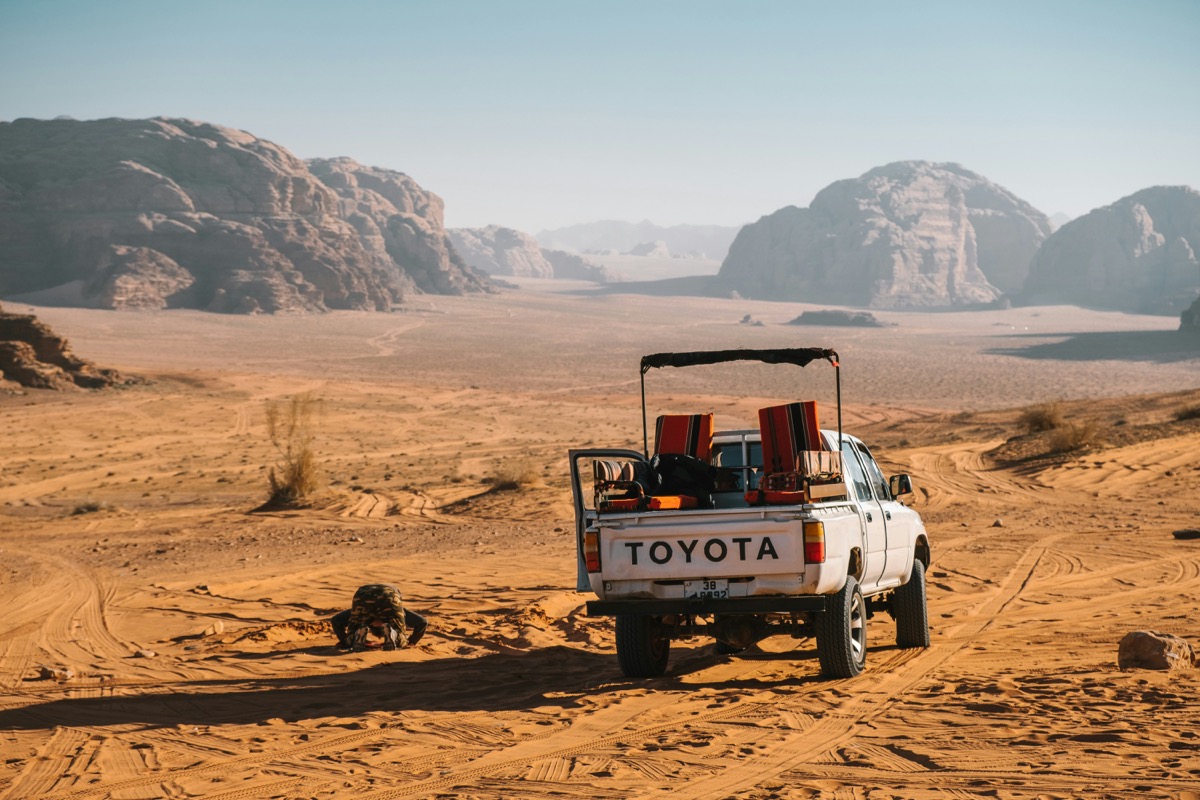
Everything in Wadi Rum runs through Bedouin-owned operations. The Rum Village Visitor Centre is where tours depart, camp pickups are coordinated, and balloon flights begin. The visitor centre has a small museum and a permit office - independent access to the reserve beyond the village requires a permit that comes with any booked tour. For an overview of the desert landscape, what to expect from each activity type, and when to visit, see Things to Do in Wadi Rum.
Book a Wadi Rum Tour
| Tour | Duration | From | Book |
|---|---|---|---|
| Wadi Rum 4-Hour Jeep Safari (morning or sunset) | 4.5 hrs | $47/person | Book → |
| Wadi Rum Flexible Jeep Pass (2–9 hrs, choose on the day) | 2–9 hrs | $30/person | Book → |
| Jeep Tour with Overnight Desert Camping | 2 days | $126/person | Book → |
| All Wadi Rum tours | — | — | Browse on GYG |
Prices verified from GetYourGuide / TripAdvisor as of 2026. Per-person rates decrease with group size.
Jeep Safari Options
The standard vehicle is a Toyota Land Cruiser or equivalent pickup truck with an open rear cabin fitted with benches. Your Bedouin guide drives; passengers sit in the rear. The experience is significantly different from a closed-vehicle game drive - wind, dust, sun, and the smell of the desert are all part of it.
2-Hour Jeep Safari
Coverage: The nearest major sites to Rum Village - Lawrence’s Spring, the Abu Aineh inscriptions area, and the edge of the red sand dune field. Good introduction to the scale of the landscape; insufficient for the deeper desert formations.
Best for: Visitors with a single afternoon in Wadi Rum, or those combining with an Aqaba or Petra visit on the same day and cannot spare more time.
Price (as of 2026): Approximately JOD 25–35 per person for a shared 4-seat vehicle. Solo travellers pay the full jeep rate (approximately JOD 70–80 total) unless added to a group.
4-Hour Jeep Safari (Recommended Minimum)
Coverage: The main circuit - Lawrence’s Spring, Khazali Canyon (Nabataean inscriptions carved into a narrow siq), the Anfaishiyya rock inscriptions, Um Fruth rock bridge (climbable), and the large red sand dunes where sandboarding is possible.
Why it’s the recommended minimum: The 4-hour circuit covers the features that justify the visit. The 2-hour route reaches only the near-desert edge. The extra 2 hours doubles the distance and reaches the dune field and rock bridges that most people have in mind when they think of Wadi Rum.
Price: Approximately JOD 40–55 per person shared.
Full-Day Jeep Safari (7–8 Hours)
Coverage: Everything in the 4-hour circuit plus the far desert sites: Burdah Rock Bridge (Jordan’s highest natural arch), the Khaz’ali Canyon full walk, Jabal Rum approaches, and the south desert area with views toward Saudi Arabia. Lunch is eaten in the desert (usually a Bedouin meal prepared at a shaded spot).
Best for: Visitors with a full day who want the complete Wadi Rum experience without an overnight stay, or as Day 1 of a 2-day stay before an overnight camp on Day 2.
Price: Approximately JOD 65–90 per person shared. Private full-day jeep for 2 people: approximately JOD 120–150 total.
Overnight Bedouin Camps
Spending a night in the desert is widely regarded as the most memorable Jordan experience available. The combination of extreme silence, no light pollution, and a sky that reaches density after midnight that is not visible from anywhere with ambient light is worth the additional night.
Standard Bedouin Camps
Standard camps are the foundation of Wadi Rum’s accommodation offer - basic goat-hair or cotton canvas tents, ground mattresses, communal bathroom blocks, and a central fire area where guests gather in the evening. Dinner is typically prepared in the traditional zarb style: meat and vegetables buried in a sand pit over hot coals for 2–3 hours, lifted and served communally.
Price range: Approximately JOD 20–35 per person per night including dinner and breakfast.
What to expect: Authentic but basic. The main selling point is the atmosphere, not the infrastructure. Bathroom facilities are adequate; beds are on the ground or on low cots. Temperature regulation (warm in summer, cold in winter) depends on what you bring. Camps provide blankets and basic sleeping arrangements.
Notable standard camps: Mohammed Mutlak Camp (long-established, multilingual guides), Rum Stars (popular with solo travellers for the communal atmosphere), Bedouin Lifestyle Camp (small, family-run, emphasis on traditional food and storytelling).
Luxury Camps
The luxury camp category in Wadi Rum operates at a level significantly above the standard tier - and prices accordingly.
Memories Aicha Luxury Camp: Offers raised canvas-and-wood tents with proper double beds, en-suite bathrooms with hot showers, and electricity. The camp sits in a position with an unobstructed view of the Umm Ishrin mountain range. Rates from approximately JOD 150–200 per night for 2 people, including dinner and breakfast. The bubble dome tents (acrylic dome ceilings for star viewing from bed) are the premium option at approximately JOD 250–300 per night. Book well ahead for these - available inventory is small and demand is high from March–November.
Wadi Rum Night Luxury Camp: One of the most reviewed luxury options on the Wadi Rum accommodation platforms. Offers both dome tents and traditional Martian-style bubble accommodations. Rates approximately JOD 180–250 for standard luxury tent, JOD 280–350 for the signature transparent dome. Includes dinner, breakfast, and a 2-hour jeep excursion. The camp is positioned for a full eastern horizon view - sunrise over the red canyon wall is the visual payoff.
Hasan Zawaideh Camp: Mid-range between standard and full luxury. Raised tents, private bathrooms, and structured dinner programme. Rates approximately JOD 80–120 for 2 people. A reasonable middle option for visitors who want more comfort than a basic camp but are not looking for the full luxury experience.
Rum Canyons Camp: Smaller operation (max 12 guests) positioned in a more remote section of the desert. Emphasises exclusivity and a guided focus. Rates approximately JOD 200–280 per night for 2, including guided activities.
Camel Rides
Camel rides in Wadi Rum are offered as standalone excursions (1–2 hours) or as add-ons to jeep safari packages. Most Bedouin camp stays include an optional camel ride in the morning or evening.
Standalone camel ride: Approximately JOD 15–25 per person for a 1-hour guided ride departing from Rum Village or from your camp.
Sunset camel ride: The most popular variation - a 1–1.5 hour ride timed to arrive at an elevated viewpoint for sunset. Operators: Rum Riders (long-established, multiple-language guides), Wadi Rum Camel Tours (flexible times).
Multi-day camel trek: Possible but uncommon. 2–3 day camel expeditions through the far desert are offered by specialist Bedouin operators - primarily for experienced visitors or trekking groups. Price negotiable directly with the Bedouin guides in Rum Village; approximately JOD 100–150 per day per person, including guide, food, and camp setup.
Hot Air Balloon Flights
Wadi Rum hot air balloon flights depart in the early morning (6am) and last approximately 1 hour in the air, covering 15–25km of desert depending on wind conditions.
Operator: Royal Aero Sports Jordan is the primary operator and has the longest operating history in Wadi Rum. A second operator, Wadi Rum Balloon, has operated more recently.
Price: Approximately JOD 150–200 per person as of 2026. Advance booking is mandatory - flights operate on fixed schedules with limited capacity per basket.
What to expect: The balloon launches from near Rum Village in the pre-dawn darkness, rises as the sun appears over the eastern mountains, and drifts southwest over the desert for an hour. The view of the Wadi Rum terrain from altitude - red dunes, rock formations, Bedouin camps visible below - is the attraction. A champagne or traditional tea celebration follows landing.
Weather dependency: Flights are cancelled in wind above a safe threshold (approximately 25km/h). Cancellations happen with advance notice (weather is assessed the evening before). Refunds or rescheduling are standard in these cases.
Booking: Book directly with Royal Aero Sports Jordan (+962 77 790 0102) or through most Wadi Rum camp operators, who can coordinate as part of a package.
Organising the Logistics
Arriving at Wadi Rum: The Visitor Centre at Rum Village is 8km off the Desert Highway (Route 15), accessed via a signed junction. There is no public transport to Rum Village; a taxi from Aqaba costs approximately JOD 30–40 (1 hour), from Wadi Musa (Petra) approximately JOD 60–80 (1.5 hours). Tour packages from Amman or Petra include transport.
Jordan Pass and entry: The Jordan Pass does not cover the Wadi Rum site entry fee (approximately JOD 5 per person, waived for overnight camp guests - the camp fee includes the reserve entry). Jeep safari tickets and Wadi Rum experiences can be pre-booked in advance before travel.
What to bring for overnight stays:
- Warm layer (temperatures drop sharply at sunset year-round; winter nights can reach -5°C)
- Headtorch (camp lighting is minimal)
- Cash in JOD (most camps do not accept cards)
- Camera with wide-angle lens or a phone with a dedicated astrophotography mode for star shooting
Booking: For standard camps, booking on arrival at the Visitor Centre is possible in low season. In peak season (March–April, October–November) and for any luxury camp booking, book 1–2 weeks in advance through the camp directly or via GYG/Viator where available. You can browse Wadi Rum jeep safaris, overnight camps, and balloon flights to compare operators and secure your spot ahead of arrival. Planning on short notice? Check last-minute tours in Jordan - we refresh availability twice daily.
See also: Wadi Rum visitor guide · Things to Do in Wadi Rum · Best Camps in Wadi Rum · Petra visitor guide · Aqaba visitor guide