Umm ar-Rasas is Jordan’s quiet UNESCO site. It sits in open farmland south-east of Madaba, and most visitors only mention it as an optional stop. UNESCO inscribed it in 2004 as Um er-Rasas (Kastrom Mefa’a), and its mosaics and its unusual tower make it worth the detour. Our Byzantine mosaics guide covers it briefly; this page is the full visit guide.
The Town Behind the Name
Inscriptions in the churches show that the ancient name was Kastron Mefa’a. It began as a Roman military camp (castrum) and grew into a Byzantine town, and it continued through the early Islamic centuries, with the main settlement abandoned around the 9th century. A rare feature of the site is that people kept building Christian churches here long after the Arab conquest, producing mosaic work well into the Umayyad and early Abbasid period.
UNESCO’s listing recognises the continuity of life from the Roman era, the remains of at least 16 churches, many with mosaic floors, and the walled military enclosure. Official details are on the UNESCO World Heritage page.
What to See
The Church of St Stephen. The star attraction. Its floor mosaic is dated by inscription to 785 CE and shows a ring of cities from Jordan, Palestine and the Nile Delta, along with hunting, fishing and farming scenes. Look closely at the human figures: many were deliberately damaged in a later iconoclastic phase, while the animals and buildings survived. The mosaic sits beneath a protective shelter, and a raised walkway lets you view it from above.
The Church of the Lions and nearby churches. Smaller churches show other mosaic styles and inscriptions, including images of local donors.
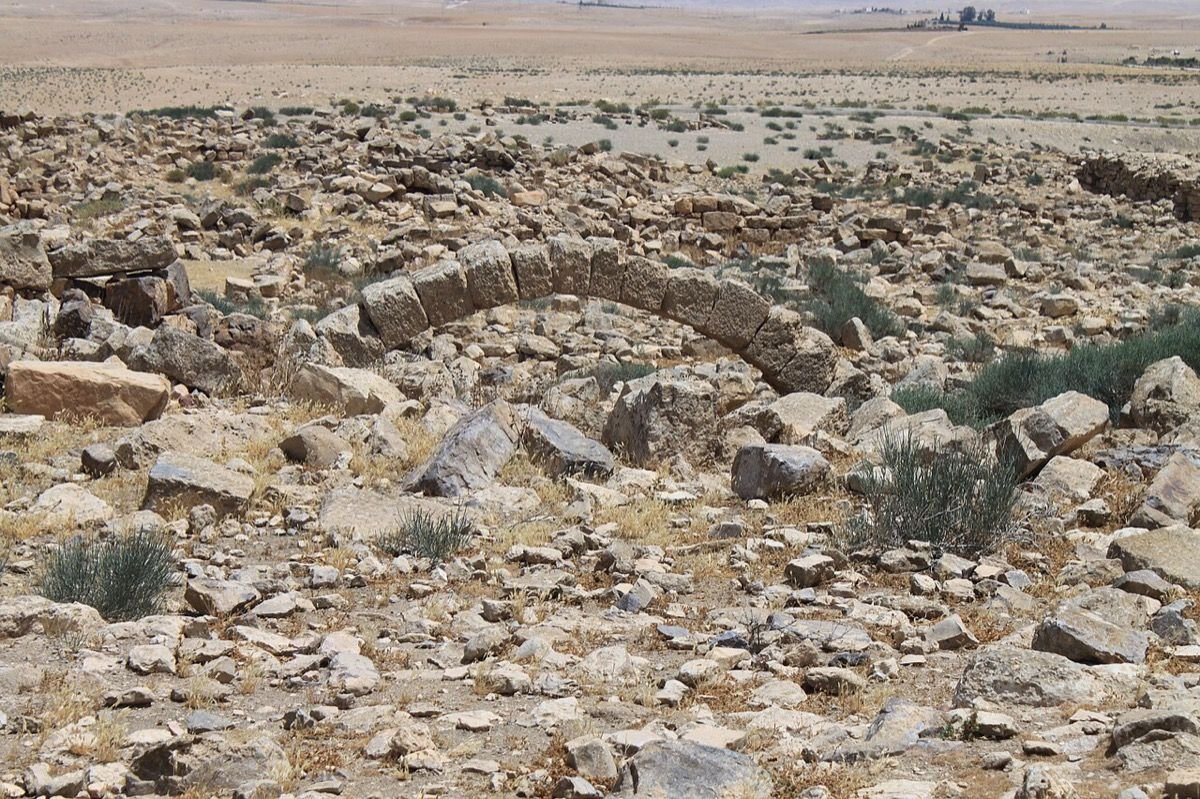
The walled camp. The rectangular Roman enclosure is easy to trace, with ruined arches and foundations.
The stylite tower. A tall, square tower stands a short walk north of the main ruins, roughly 14 metres high. It is associated with stylites, ascetics who lived on pillars or in towers, and it is a rare survivor of its kind in the region. Climbing is not allowed, but its scale is striking against the empty plain.
Practical Planning
- Getting there: no public transport. A rental car is the best option; alternatively arrange a driver from Madaba, or book a guided tour from Madaba that includes Umm ar-Rasas.
- Cost: as of 2026, around JOD 3 has been quoted for entry; confirm locally. Our Byzantine mosaics page uses the same figure.
- Time: allow 1.5 to 2 hours on site, plus about an hour each way from Madaba.
- Facilities: minimal. Bring water, a hat and sun protection; summer heat is intense, and spring is the best season.
- Best order: Madaba mosaics in the morning, Mount Nebo at midday, then Umm ar-Rasas in the afternoon before returning to Amman.
Reading the St Stephen Mosaic
The St Stephen floor is organised like a cartographic poster. A border shows cities of Egypt and the Nile Delta, labelled in Greek. Inside, further panels name towns of Palestine and Jordan, each drawn as a walled settlement with towers and gates, alongside vineyards, fishing and hunting scenes. Inscriptions record the donors and the date, so historians treat the floor as a fixed point for dating other mosaics in the region. Compare it with the famous map in Madaba to see how workshops copied and adapted a shared tradition.
Tips
Hire a local guide at the site entrance if one is available, as the inscriptions are easy to miss without help. Bring a hat even in winter, and wear shoes with grip for the loose gravel between the churches. The shelter protects the mosaic but can be dim, so a phone torch helps with the details.
Why It Matters
Most Byzantine sites in Jordan are single churches inside bigger towns. Umm ar-Rasas lets you walk through a whole provincial settlement, from soldiers’ camp to monastic town, and see how Christian art survived under Muslim rule. If you only have time for one UNESCO site beyond Petra and Wadi Rum on the King’s Highway side, this is the one with the most to teach. For other options on the route, see day trips from Madaba, and consider a night in a Madaba hotel to make the loop unhurried.