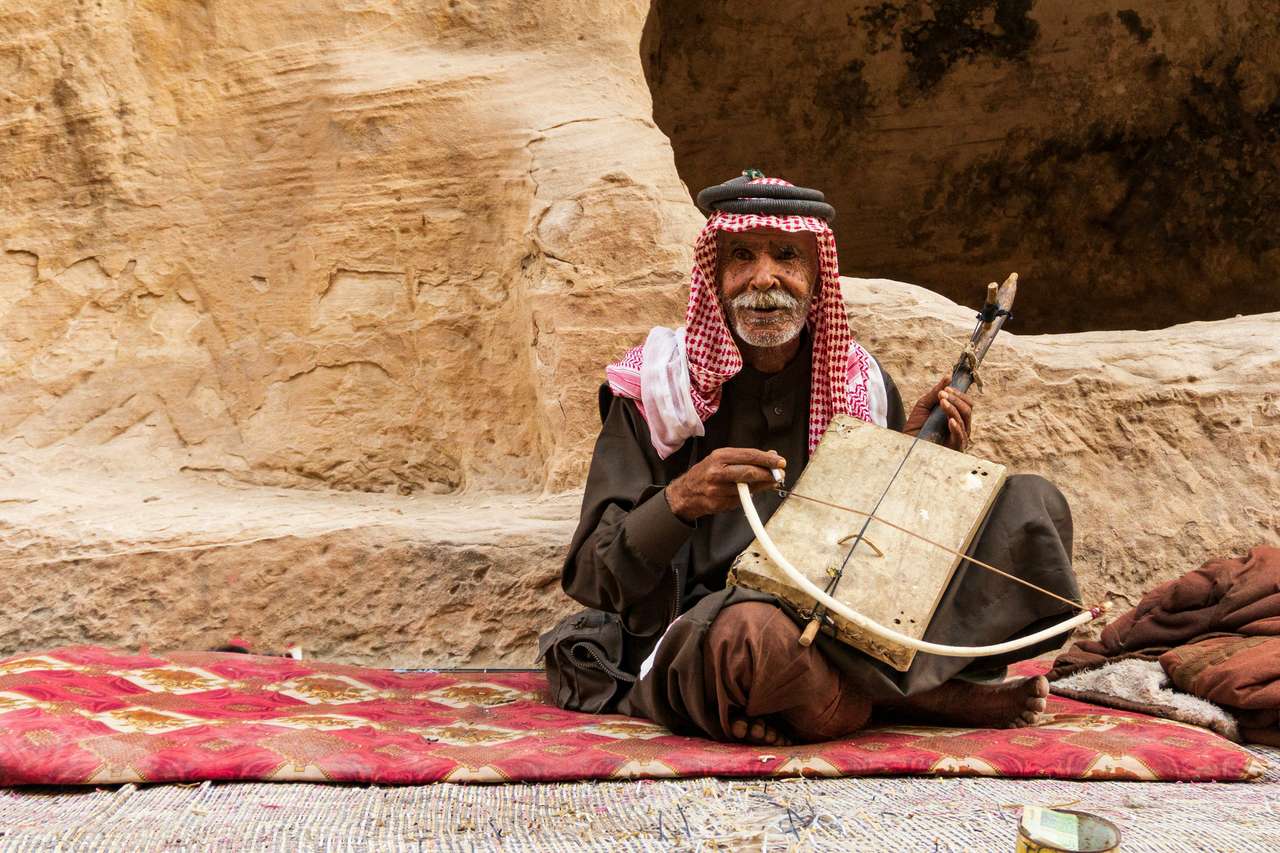
Jordan is a country shaped by desert. Before Petra had tourists, before Amman had tower blocks, the Bedouin were here — navigating the steppe, memorising wells, building a culture of hospitality so refined that a stranger could arrive at any tent and leave fed, sheltered, and escorted to the next waypoint. That culture still exists, and it is more accessible to visitors than most people realise.
The Tribes and Their Territories
Jordan’s Bedouin population numbers around 1.5 million. The tribes are distinct, with different territories, dialects, and histories.
The Beni Sakhr are the largest and most politically influential tribe in Jordan. Their traditional territory stretches across the central highland plateau between Amman and Azraq. During the Arab Revolt of 1916–1918, Beni Sakhr leaders allied with Sharif Hussein and T.E. Lawrence’s forces — a partnership that shaped the modern Jordanian state. The tribe has deep ties to the royal court; several senior government ministers over the past century have been Beni Sakhr.
The Howeitat dominate the southern desert. Their territory runs from Wadi Rum through the Hisma plateau and into northwestern Saudi Arabia. Many of the Bedouin guides operating in Wadi Rum today are Howeitat. The tribe gained international attention in 2020 when a Howeitat man, Abdul Rahim al-Howeitat, was killed resisting relocation to make way for NEOM in Saudi Arabia — a dispute that highlighted ongoing land rights tensions across the region.
The Rwala are a vast confederation whose range historically crossed Jordan, Syria, and Iraq. In Jordan they concentrate in the northeastern Badia — the arid steppe between Mafraq and the Iraqi border. The Rwala are known for their camels; they maintained some of the largest herds in the Arabian Peninsula and supplied livestock to markets from Damascus to Medina.
The Azazmeh occupy the Wadi Araba rift valley and the Negev fringe, a territory that now straddles Jordan and Israel. The tribe is semi-nomadic, seasonally moving goat herds between the Jordan Valley and higher ground. Because their territory crosses a contested international boundary, the Azazmeh have dealt with displacement more acutely than most — a community that was nomadic by design now navigating the logistics of a hard border.
The Bdoul subtribe, technically a branch of larger confederations, are the Bedouin most closely associated with Petra. They inhabited the cave dwellings inside the archaeological site until 1985, when the Jordanian government relocated them to the purpose-built village of Umm Sayhoun, about two kilometres from the main gate. Many Bdoul families continue to work inside Petra selling souvenirs, offering donkey rides, and guiding visitors.
Mansaf: The Grammar of Hospitality
Mansaf is not just food. It is a formal statement about who you are and what you owe a guest. The dish — lamb slow-cooked in jameed (sun-dried, fermented goat’s milk) dissolved in water to make a tart, nutty broth, served over flatbread and rice and garnished with toasted almonds and pine nuts — is prepared for weddings, funerals, tribal negotiations, and any significant gathering. Making it for a casual Tuesday dinner is not done.
The preparation begins with the jameed itself. The dried yogurt balls are soaked in warm water overnight and then simmered until they dissolve into a pale yellow sauce. The lamb — whole quarters, not portions — is cooked separately in salted water, then finished in the jameed broth. The rice is layered first on the communal tray (sahn), then the flatbread (shrak), then the meat on top, with the jameed sauce ladled generously over everything.
Service follows a strict protocol. Guests stand around the tray and eat with the right hand, rolling rice into balls against the side of the tray before raising them to the mouth. The host does not eat until the guests have started, and he periodically adds more meat to the tray throughout the meal. When a guest has had enough, he takes a small step back from the tray. It is polite to eat more than you want and to take a second position at the tray when invited — this signals the host’s Mansaf was good enough to inspire excess.
Wadi Rum Camps: Authentic vs Tourist-Oriented
Wadi Rum has more than 60 registered camps. The range is enormous — from simple Bedouin-run tents where you sleep on wool mattresses and a local family cooks over open fire, to Instagram-marketed bubble dome operations with private bathrooms and mood lighting.
Bedouin Meditation Camp (run by the Zalabia family, JD 25 per person, dinner and breakfast included) is a straight-talking operation — shared Bedouin tents, home-cooked food, no generator noise after 10pm. The family has worked in Wadi Rum for three generations. This is the kind of camp where the host will sit with you after dinner and explain which stars the camel caravans navigated by.
Wadi Rum Night Luxury Camp (JD 55–75 per person) occupies a middle ground — upgraded canvas structures with proper beds, private bathrooms added in recent years, and a kitchen that produces solid Bedouin food without the theatrics. Good choice for travellers who want comfort without feeling they’ve entered a film set.
Memories Aicha Luxury Camp and Rum Stars Bubble Camp are at the premium end, with transparent domed tents from JD 120–180 per night. Both are professionally run and visually striking, but the experience is closer to boutique hotel than Bedouin camp. Worth knowing if aesthetics matter more than cultural immersion.
For the most authentic experience, book directly rather than through aggregators — WhatsApp numbers circulate on Wadi Rum community Facebook groups, and booking direct means a larger share goes to the family running the camp.
Music, Poetry, and the Rababa
Bedouin musical identity centres on the rababa — a single-string fiddle made from a wooden frame, goatskin soundboard, and horsehair bow. The instrument produces a thin, nasal sound that carries across open desert. It is always played in the context of poetry recitation, not as background music.
Qasid (singular: qasida) is the formal Bedouin oral poetry tradition. A skilled poet — a sha’er — composes verse extemporaneously, using a strict metre, to mark events: a battle victory, a marriage, a dispute settled, a guest honoured. Attending a Bedouin gathering where a sha’er performs is a genuinely rare experience. The closest accessible version for visitors is the evening gatherings at authentic camps in Wadi Rum, where older Bedouin men often perform qasid after dinner.
The Jordanian government recognises Bedouin performing arts as intangible cultural heritage. The annual Jordan Folk Festival in Jerash (held in July) features Bedouin musical ensembles alongside classical Arab music — a structured opportunity to hear rababa and qasid in a formal context.
Camel Trekking: Named Guides and Routes
Camel trekking in Wadi Rum is not a tourist amusement. It is the original mode of long-distance travel across the Hisma plateau, and doing it properly — two or three days on camelback, sleeping in the open desert or at small camps — gives a physical understanding of Bedouin geography that a jeep tour cannot.
Sabbah Eid (Bedouin Ways, based at Rum village) runs 2–4 day treks starting at JD 45 per person per day, including food and camp. The standard route goes south from Rum village through Khazali Canyon to the dunes near Burdah Rock, finishing near the Saudi border at Disah. Sabbah’s family are Howeitat; he grew up on this land and navigates by landmarks rather than GPS.
Atallah Zalabia (also Rum village-based) specialises in longer crossings for experienced riders: the five-day Rum to Aqaba route, covering approximately 70 kilometres south through the Hisma, is available for JD 65 per person per day. It ends at the Gulf of Aqaba, which historically was the endpoint of camel caravan routes connecting the Hejaz to Mediterranean ports.
Both guides can be contacted through Wadi Rum’s visitor centre or via the Royal Society for the Conservation of Nature tourism office in Rum village.
The Petra Bdoul and Dana Village
Inside Petra, the Bdoul community sell handicrafts (embroidered bags, silver jewellery, painted pottery) from stalls along the main siq and at the High Place of Sacrifice. Their work is genuinely craft, not factory import. A conversation with a Bdoul vendor, if you have twenty minutes and a willingness to sit, will cover the history of the relocations, family lineage, and opinions on the current management of the site.
Dana Biosphere Reserve, 35 kilometres north of Petra, is home to a small Bedouin farming community. The village of Dana itself — stone houses clinging to the escarpment above the Wadi Dana — is accessible only on foot or by 4WD. The RSCN guesthouse offers basic accommodation (JD 35–50 per night), and local guides (JD 15–20 per half day) lead walks through the reserve. Dana represents a different Bedouin adaptation — not the camel-herding nomadism of Wadi Rum, but a settled agropastoral culture that terraced hillsides and managed water springs for centuries.
Both communities are worth time beyond a hurried visit. The most lasting thing about Bedouin culture in Jordan is not any specific ritual or dish — it is the underlying logic that a stranger’s presence creates an obligation rather than a problem.