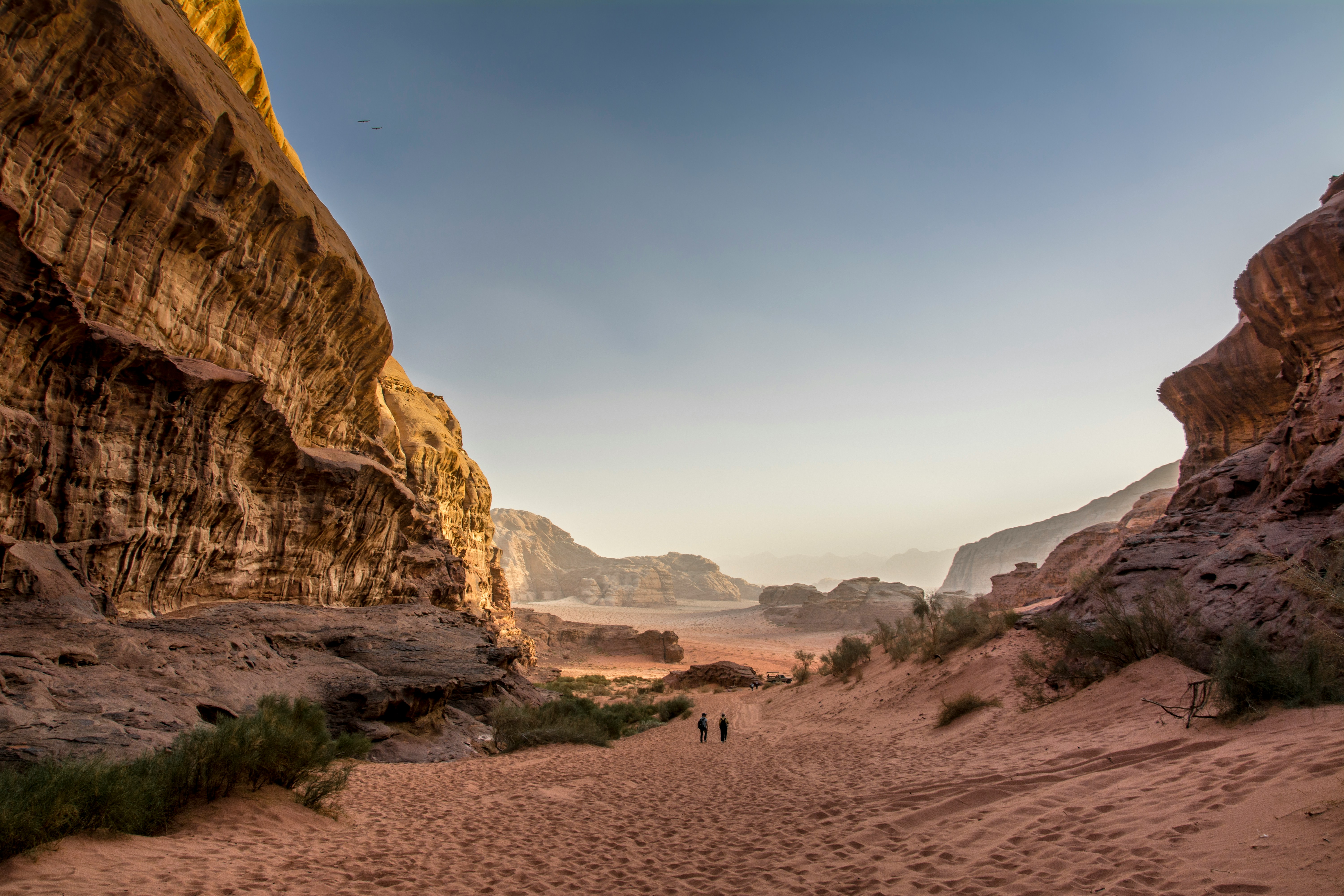
Dana Biosphere Reserve is Jordan’s largest nature reserve: 320 square kilometres of terrain that spans four distinct ecological zones and drops more than 1,600 metres from a sandstone plateau above sea level to the floor of the Rift Valley below it. No other place in Jordan concentrates such biodiversity in a single day’s walk - or offers the combination of Ottoman-era village, canyon landscapes, and a solar-powered ecolodge at the end of a desert valley.
This guide covers who the reserve suits, what to expect from its different zones, the wildlife you are likely to see, accommodation options, the RSCN permit and guide system, and how to plan your visit depending on how much time you have.
The Four Ecological Zones
The reserve’s defining characteristic is its elevation range. Dana village sits at approximately 1,200 metres on the eastern plateau rim. The canyon descends to Wadi Araba at around -200 metres (below sea level). That 1,400-metre drop through a single canyon system passes through four distinct environments:
Mediterranean scrubland (upper reserve, 1,000–1,500 m): Juniper woodland, wild olive, and pine. Cooler and wetter than the lower sections, this zone supports the widest range of bird species and is where Nubian ibex are most commonly spotted. Rummana Campsite sits in this zone.
Irano-Turanian zone (mid-canyon, 500–1,000 m): Transitional scrub with artemisia and other drought-tolerant shrubs. This is the most botanically diverse section of the reserve - over 700 plant species have been recorded across the reserve as a whole, with many endemic or rare species concentrated in this transition band.
Sudanian zone (lower canyon, 0–500 m): Acacia and tamarisk woodland takes over. The terrain opens out into a wide, sandy valley. Shade becomes scarce and temperatures rise sharply. This is the territory of sand foxes and lizards.
Saharo-Arabian desert (Wadi Araba floor, below sea level): The flat desert floor where Feynan Ecolodge sits. Acacia trees are the only vegetation. Night skies here are exceptional - no light pollution reaches the valley floor.
Wildlife
Nubian ibex: Dana’s most reliably spotted large mammal. These wild goats, with long curved horns, navigate near-vertical canyon walls with unsettling ease. Rummana Campsite at dawn is the best location - the ibex move to the cliff faces in the morning light, often in groups of 4–10. Numbers across the reserve are estimated at several hundred.
Carnivores: Sand foxes (Vulpes rueppellii) are present in the lower zones and occasionally spotted near Feynan at dusk. Wolves and striped hyenas are documented in the reserve but are rarely seen by visitors. Blanford’s fox, a small cliff-dwelling fox, has been recorded in rocky sections of the upper canyon.
Birds: 215+ species recorded, making this one of Jordan’s best birding sites. Key species include:
- Bonelli’s eagle - resident breeder, seen riding thermals above the canyon
- Verreaux’s eagle-owl - occasionally heard calling at Feynan after dark
- Syrian serin - small finch, found in the juniper woodland around Dana village
- Long-billed pipit and Tristram’s starling - both common in the reserve
- Pallid harrier and Montagu’s harrier - winter passage migrants
Spring migration (late March to May) significantly expands the species count. Bring binoculars - the canyon walls create distance that makes naked-eye identification difficult.
Reptiles: The reserve supports multiple lizard species including the starred agama, which displays vivid blue coloration in the breeding season. The Saharan horned viper is present in the lower desert sections - watch where you place hands when scrambling.
Dana Village
Dana village is a small, partially restored Ottoman-era settlement of stone houses built on a narrow ridge above the canyon. Most houses date from the 17th–19th centuries; some are still inhabited, others are ruins. The RSCN has restored several buildings as guesthouses and craft workshops.
The Dana Guesthouse is the most accessible accommodation in the reserve. Run by the RSCN, it sits at the village edge with canyon views. Shared-bathroom rooms run approximately JOD 25–40 per person per night as of 2026, typically including breakfast. It is a functional, comfortable base for day hikes rather than a luxury retreat - but the terrace view over the canyon at dusk is one of the better views in southern Jordan.
The craft centre sells RSCN-produced items including pottery, silver jewellery, and natural soap - proceeds support community employment. It is worth visiting regardless of whether you intend to buy.
The village has no shops selling hiking supplies, food beyond what the guesthouse kitchen provides, or phone signal in most locations. Come prepared from Amman, Wadi Musa, or Aqaba.
Rummana Campsite
Rummana Campsite sits 8 kilometres north of Dana village by road, in the upper Mediterranean zone at around 1,100 metres. It is the best single location in the reserve for Nubian ibex sightings and for birding.
Overnight camping at Rummana costs approximately JOD 15–20 per person as of 2026, including a tent and basic facilities. There is no restaurant - bring your own food. The site has toilets and a small shelter. Arriving at Rummana the evening before a planned hike, then starting at dawn, is the most wildlife-productive approach.
Getting to Rummana: The access road from Dana village is rough and a 4WD vehicle is preferable for the final section. If you have a standard car, drive slowly and check road conditions with the RSCN visitor centre before departing. RSCN staff can sometimes arrange a lift for visitors staying at the Dana Guesthouse - ask at the centre.
Trail Guide
Dana’s four marked trails cover the range from a free 1-hour village loop to a demanding 14-kilometre full-day descent. All guided trails are booked at the RSCN visitor centre in Dana village - guide availability can be limited in peak season, so book the afternoon before your planned hike.
Trail 1 - Dana Tower Trail (Easy, No Guide Required) Distance: 2 km loop | Time: 1–1.5 hours | Elevation gain: ~100 m
The Dana Tower Trail starts from the village edge, climbs briefly to a viewpoint ridge, and loops back. It is free to walk, needs no guide, and is well-marked with RSCN trail signs. The viewpoint gives the widest free panorama over the reserve canyon. This is the right trail if you have limited time, are hiking with children, or want an orientation walk before a longer route.
Trail 2 - Rummana Mountain Loop (Moderate, Guide Required) Distance: 4–5 km loop | Time: 2.5–3.5 hours | Elevation change: ~200 m
Starting from Rummana Campsite (8 km north of Dana village by road), this loop climbs toward the plateau rim through juniper and oak woodland. Rummana at dawn is the best location in the reserve for Nubian ibex sightings - start before 8am. Overnight camping at Rummana is available for approximately JOD 15–20 per person (basic facilities, no restaurant). The access road from Dana village is rough - a 4WD is preferable for the final section.
Trail 3 - Wadi Ghwayr Canyon (Moderate–Challenging, Guide Required) Distance: 7 km loop | Time: 4–5 hours | Best season: March–May
Wadi Ghwayr is the reserve’s water canyon - in spring, a seasonal stream runs through sections of it, making this one of the few shaded, wet hikes available anywhere in Jordan. The trail involves scrambling through the canyon streambed, crossing the stream repeatedly. Sturdy footwear with ankle support is essential; sandals are not appropriate. By late June the stream may be dry, removing both the shade and the main appeal. In winter the canyon can be cold and slippery.
Trail 4 - Wadi Dana Descent to Feynan (Moderate, Full Day, Guide Required) Distance: 14 km point-to-point | Time: 5–7 hours | Elevation loss: ~1,000 m
The Wadi Dana trail is the reserve’s signature route. Starting at Dana village, it descends through all four ecological zones to emerge at Feynan Ecolodge on the desert floor. The gradient is manageable but the distance and exposure require solid preparation. Critical logistics: the trail is point-to-point and Feynan is extremely remote - most people who walk it stay overnight at Feynan and arrange a 4WD transfer back to Dana the following morning (approximately JOD 30–40 for the vehicle, organised through the lodge). Arrange return transport before you start - there is no taxi rank at Feynan.
Feynan-to-Dana Uphill Variant: The same trail can be walked in reverse, starting from Feynan Ecolodge and climbing to Dana village. This approach suits travellers arriving from the west via the Wadi Araba road (the route from Aqaba or the Wadi Rum area). Feynan can be reached by 4WD from the Wadi Araba road; ask the lodge to arrange a driver. Allow 6–8 hours for the uphill direction - harder on effort but cooler in the exposed lower section if you start at dawn.
What to Bring
The reserve has no shops. Bring all supplies from Amman, Wadi Musa, or Aqaba.
- Minimum 3 litres of water per person (5 litres for the Wadi Dana full-day route)
- High-SPF sunscreen and a hat - the lower canyon is fully exposed
- Sturdy footwear with ankle support - trail runners are acceptable for the Tower Trail and Rummana, boots strongly recommended for Wadi Ghwayr and Wadi Dana
- Snacks and a packed lunch (the Dana Guesthouse kitchen can prepare one with advance notice)
- Light layers - mornings at Dana village are cool even in May
- Headtorch if there is any chance of finishing after dark
- Trekking poles for the Wadi Dana descent (the long downhill puts pressure on knees)
- For Wadi Ghwayr: waterproof shoes or accept wet feet; dry bag for any electronics
Feynan Ecolodge
Feynan Ecolodge sits on the western desert floor of the reserve, accessible from the east only by walking the full Wadi Dana trail (14 km, 5–7 hours) or from the west by 4WD via the Wadi Araba road. It is off-grid: solar power only, no Wi-Fi, lighting by candle and lantern after dark. Roughly 26 rooms cost approximately JOD 80–120 per person per night as of 2026, including dinner and breakfast.
The lodge functions as an eco-tourism anchor for the local Rassoun community - staff are recruited locally, and profits support conservation in the reserve. The experience is deliberately stripped back: no phone signal, no screens, firelight in the evening, and a sky full of stars at night. It consistently rates among Jordan’s most memorable places to stay.
Booking: Through rscn.org.jo only. Walk-ins are not accepted. Book at least 2 weeks in advance for March–May visits; outside peak season, 5–7 days’ notice is usually sufficient.
Western access: If you are travelling from Aqaba or the Wadi Rum area, Feynan can be reached from the Wadi Araba road by 4WD without hiking the Wadi Dana trail. The lodge can arrange a driver from the roadside turnoff - request this when booking.
RSCN Permit and Guide System
The Royal Society for the Conservation of Nature (RSCN) manages the entire reserve. Access is structured rather than open:
Entry fees (as of 2026):
- Dana Tower Trail: free
- All other trails: approximately JOD 5–7 per person per day
Guide fees:
- All guided trails (Wadi Dana descent, Rummana Mountain loop, Wadi Ghwayr): approximately JOD 15–25 per group, regardless of group size
- Guides are mandatory for these trails - this is enforced, not optional
Booking guides: At the RSCN visitor centre in Dana village, ideally the afternoon before your planned hike. The centre’s opening hours vary by season - arrive before 5pm. Online booking is not available for trail guides; the process is in person. The RSCN website (rscn.org.jo) lists email contacts for advance enquiries.
Jordan Pass and Dana: The Jordan Pass covers entry to Petra and several other attractions but does not cover Dana Biosphere Reserve trail fees. These are paid separately at the RSCN visitor centre.
How Long to Spend
Half day: Dana village, the free Tower Trail viewpoint, and the craft centre. Suitable if Dana is a stop on a King’s Highway drive rather than a primary destination.
One full day: Base at Dana Guesthouse, take the Rummana Mountain loop or Wadi Ghwayr trail with an RSCN guide. This gives a proper experience of the reserve without the logistics of Feynan.
Two days / one night: Arrive in Dana village mid-afternoon, walk the Tower Trail, overnight at the guesthouse, hike the Wadi Dana descent to Feynan the following day, stay at Feynan overnight, and arrange a 4WD transfer back to Dana the third morning. This is the recommended approach and gives the full reserve experience.
Three or more days: Add Rummana Campsite for dawn ibex watching, the Wadi Ghwayr canyon route in spring, and a second night at Feynan. Serious birders sometimes spend 3–4 nights at Feynan specifically for the desert bird species.
Best Season
| Month | Conditions |
|---|---|
| March–April | Best season - wildflowers, mild temperatures (15–22°C in canyon), water in Wadi Ghwayr |
| May | Warm and good; flowers fading but trails uncrowded on weekdays |
| June | Acceptable for upper trails if you start before 8am; lower canyon gets hot |
| July–August | Very hot in canyon floor (30–38°C); avoid unless experienced and well-equipped |
| September–October | Second-best window - comfortable temperatures, clear skies |
| November | Quiet, cool, and pleasant for walking |
| December–February | Cold at altitude (possible frost at Dana village), some trail closures after rain; check with RSCN |
Getting There
From Amman: 200 km south via the King’s Highway (Route 35), approximately 3 hours by private car. No direct public transport serves Dana village. Private taxi from Amman approximately JOD 50–70 one-way; arrange through your hotel in Amman or a local taxi service and agree the price before departing.
From Petra (Wadi Musa): 70 km north, approximately 1 hour by private car. Most hotels in Wadi Musa can arrange a private taxi at approximately JOD 25–35 one-way. This is the most common approach for travellers already in southern Jordan.
From Aqaba: 130 km north via the Desert Highway, approximately 2–2.5 hours by private car. Private taxi approximately JOD 60–80. Alternatively, travel north to Wadi Rum, then west and north via Wadi Araba to reach Feynan Ecolodge from the western access road.
King’s Highway tours: A guided King’s Highway drive from Amman to Petra covers Madaba, Karak Castle, Dana, and Petra over 2–3 days. Browse King’s Highway tours from Amman for group and private options that include Dana as a stop.
See also: Things to Do in Dana · Dana city hub · 10-day Jordan itinerary · Karak Castle guide