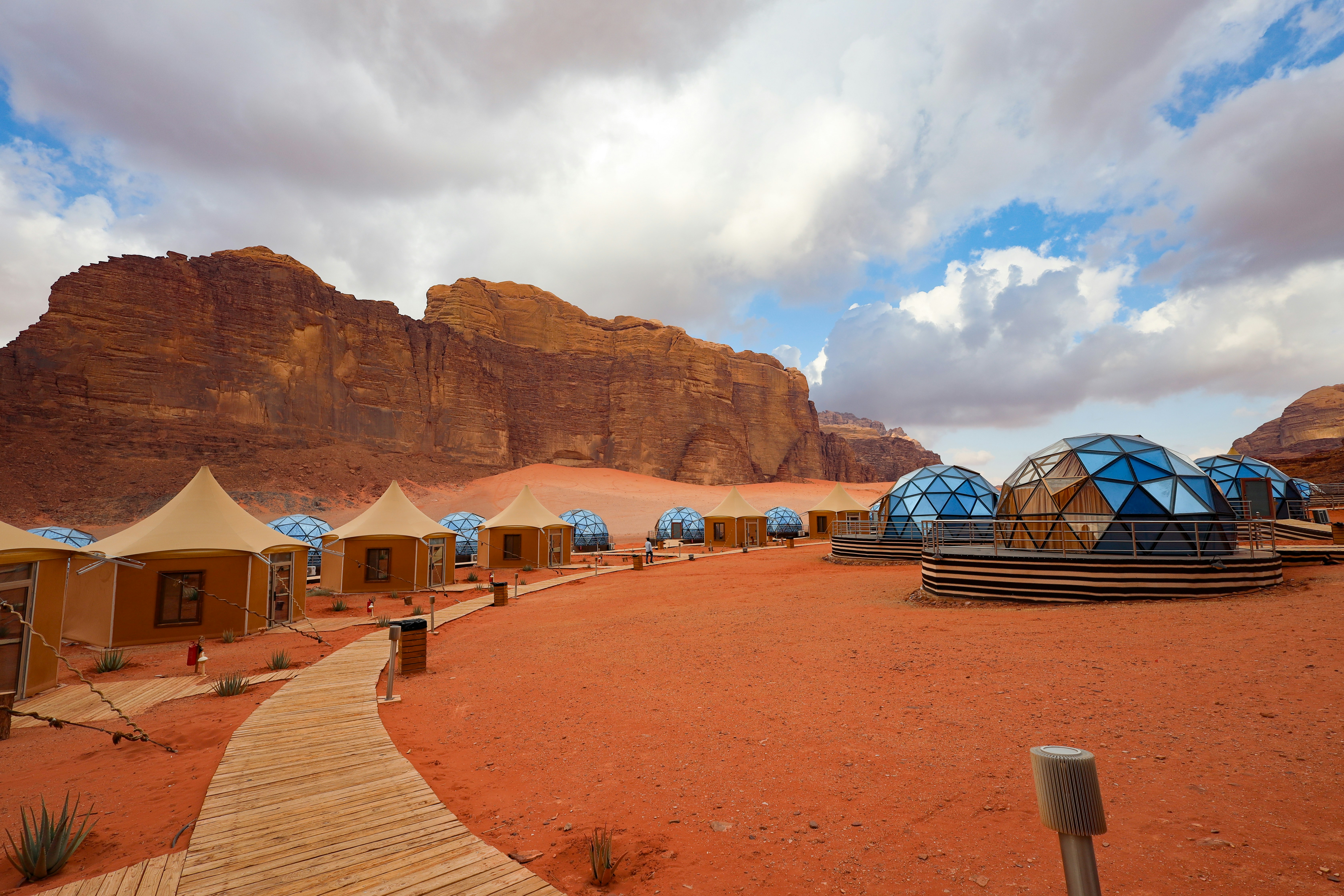
Wadi Rum is unlike any other overnight stop in Jordan. There are no hotels here in the conventional sense - accommodation is in Bedouin-style tented camps, solar-powered glamping structures, and transparent bubble domes positioned for maximum stargazing within the protected desert. The choice is not about which town to stay in or which neighbourhood suits you - it is about which tier of camp experience matches your expectations and budget.
The protected area covers approximately 720 square kilometres of red sandstone desert. Rum Village at the edge of the reserve is the access point. Camps are distributed throughout the interior - the further from the visitor centre, the more isolated and the fewer day-trippers passing through. This page covers tier comparison, pricing, what is included, transport, and booking strategy.
The Camp Experience: Why Tier Matters
The core experience - the landscape, the silence, the stars, the zarb dinner - is broadly similar across all camp tiers. What changes with price is physical comfort, privacy, and theatrical ambiance. A JOD 25-per-person basic camp gives you the same night sky and the same desert as a JOD 200-per-person bubble tent. The question is how much you value a glass ceiling, an en-suite bathroom, and the absence of generator noise.
For most travellers, the mid-range tier (JOD 50–100 per tent) represents the best value: private bathroom, proper beds, included dinner and breakfast, and a quiet camp setting without the full luxury markup.
Best Wadi Rum Camp by Traveller Type
| Traveller | Best tier | Why | Book |
|---|---|---|---|
| First-timers | Mid-range private tent | En-suite, real beds, dinner and a jeep tour usually included | Wadi Rum camps |
| Families | Mid-range private tent | Private bathroom and quieter evenings | Family-friendly camps |
| Budget | Basic Bedouin camp | Shared facilities, meals included, authentic atmosphere | Budget camps in Wadi Rum |
| Luxury and couples | Glamping or bubble dome | Air conditioning, hotel-grade beds, stargazing from bed | Luxury camps in Wadi Rum |
Camp Tier Breakdown
Basic Bedouin Camps (JOD 15-35 per person per night)
Traditional fabric or goat-hair tents on raised wooden platforms. Shared bathrooms. Communal meals, typically chicken or lamb with rice, served Bedouin-style. Dinner and breakfast almost always included.
What you get: Authentic atmosphere, genuine Bedouin contact, and a close-to-the-ground desert experience.
What you may not get: Reliable hot water, private toilet, air conditioning, electricity after midnight.
Important: Bring a sleeping bag liner or lightweight sleeping bag in any season. Desert nights drop below 5°C from November to February, and basic camp blankets are often inadequate. Basic camps change quality quickly, so read recent guest reviews on Booking.com before choosing.
Mid-Range Private Tent Camps (JOD 50-100 per tent per night)
Private safari-style tents with real beds, en-suite bathrooms (shower, flush toilet), some heating or cooling, and communal dining under a stretched Bedouin tent. Dinner and breakfast included, and a jeep sunset tour is often part of the package.
Named option: Rahayeb Desert Camp, a roughly 50-tent camp set between two large rock faces that shelter it from the wind, known for its zarb dinners.
Luxury Glamping (JOD 100-200 per tent per night)
Geodesic domes and oversized canvas structures with air conditioning, hotel-grade beds, private outdoor terraces and restaurant-style dining. Some camps add plunge pools or private viewing platforms.
Named option: Memories Aicha Luxury Camp, a family-operated Bedouin camp about ten minutes from the visitor centre, with tents and bubble domes and a notably personal guided jeep experience.
Bubble Tents and Martian Domes (JOD 105-300+ per night)
Transparent or semi-transparent domes designed for stargazing from bed, with hotel-grade interiors. Lying in bed looking at the Milky Way through a clear ceiling is genuinely extraordinary.
What to know: Inside the dome there is subtle ambient light from electronics and dome material. The full darkness and silence of the open desert is found by stepping outside. Both are worth having.
Named options:
- Sun City Camp: Offers both bubble tents and traditional canvas tents on a hillside with panoramic views. Book three to four months ahead for peak season.
- UFO Luxotel: Bubble domes with 360-degree views, just outside the protected area, around 30 minutes from the French Fortress.
Price Bands by Camp Tier
| Camp tier | Band (JOD) | USD approx | What’s included |
|---|---|---|---|
| Basic Bedouin | 15-35 per person | 21-49 | Dinner, breakfast, shared facilities |
| Mid-range private tent | 50-100 per tent | 70-141 | Dinner, breakfast, en-suite, jeep tour |
| Luxury glamping | 100-200 per tent | 141-282 | Dinner, breakfast, premium facilities |
| Bubble tent / dome | 105-300+ per night | 148-423+ | Dinner, breakfast, glass ceiling |
Tier bands as of 2026. JOD 1 about USD 1.41. Peak season (March-May, October-November) at the upper end. Check current prices per camp on Booking.com.
Getting to Wadi Rum
All camps are accessed through Rum Village at the edge of the protected area. A brief permit process happens at the visitor centre before you enter.
From Aqaba: Approximately 70 km northeast. Drive time approximately 1 hour via Route 47 east and Route 15 north.
- Taxi: JOD 25–35 per vehicle (not per person) as of 2026. Most camps arrange pickup from Rum Village if you share arrival time.
- JETT bus: the live schedule listed no Aqaba–Wadi Rum departures for 29 October to 5 November 2026, so treat it as no service and arrange a camp pickup or private transfer instead.
From Petra (Wadi Musa): Approximately 70 km south. Drive time approximately 1 hour via Route 15.
- Shared taxi / camp transfer: JOD 30–40 per vehicle as of 2026. Most camps arrange this if booked in advance.
From Amman: Approximately 290 km south via the Desert Highway. Drive time 3–3.5 hours.
- JETT bus to Aqaba (with transfer to Wadi Rum) is the public transport route. Or a direct private taxi from Amman for approximately JOD 80–100.
What is Typically Included in the Price
At almost all camps above the most basic budget level, the overnight price includes:
- Dinner - typically a zarb (meat and vegetables slow-cooked underground in a sand oven) or a BBQ spread
- Breakfast the following morning - bread, hummus, labneh, tomatoes, olives, and tea
- Tea and coffee throughout the stay
- A basic jeep tour - often a short sunset or sunrise drive
At mid-range and luxury camps, the jeep component is often more substantial - a 2-hour sunset tour or a 4-hour morning tour. Clarify what is included before booking, as camps vary. Not typically included: alcohol (some camps can arrange, but Jordan is largely alcohol-free in the desert), transfers from Aqaba or Petra, or additional jeep tours beyond the included one.
What to Bring
Cash: No ATMs in Rum Village. Bring sufficient Jordanian dinars from Aqaba, Petra, or Amman. Most camps prefer or require cash for extras (extra tours, alcohol if available, souvenirs). A few accept cards for the initial booking payment.
Travel insurance: Wadi Rum is remote - the nearest hospital is in Aqaba (approximately 1 hour). Medical cover and emergency transport is essential. Compare travel insurance options for Jordan before you go.
Warm layers: Mandatory regardless of season. Desert nights can drop 15–20°C below the daytime high. November–February: insulated jacket, hat, gloves. June–August: a light fleece is still needed after midnight.
Torch or headlamp: Camp lighting typically goes off at some point in the night at most traditional and mid-range properties. Essential for bathroom navigation in the dark.
Sunscreen: The desert sun is intense even in winter. Reapplication after any jeep tour stop is necessary.
A Night in a Wadi Rum Camp
Most stays follow the same rhythm. You arrive mid-afternoon (camps expect guests between 2 and 4pm), pay the protected-area entry fee of approximately JOD 5 per person at the Rum Village visitor centre unless your camp has already included it, and head out on a sunset jeep tour. Dinner follows around a campfire or from the zarb oven, then the lights go down. Breakfast is early, and you either return to the village or continue on a longer jeep tour. If you have already done a day tour independently, ask the camp for a reduced package rate; most Bedouin operators are flexible.
The sky is the reason to stay overnight. Light pollution is almost zero, and on a new-moon night the Milky Way is visible across the whole valley. Some mid-range and luxury camps add guided stargazing with telescopes; our stargazing in Wadi Rum guide covers the best months and moon phases. Families with children usually enjoy basic camps more than quiet luxury domes, thanks to the open fire and communal meals. For dome-specific options and how they compare with canvas tents, see our Wadi Rum bubble hotels guide, and for context on the hosts and hospitality, read Bedouin culture in Jordan.
Booking Strategy
Direct with camp: WhatsApp booking is the norm for smaller Bedouin camps. Going direct gives you flexibility to ask about what is included and to request specific tent positions - far end of the camp for more isolation, or oriented for the best sunrise view.
Booking platforms: All major platforms list Wadi Rum camps. Prices are sometimes higher due to platform fees, but payment protection and clearer cancellation policies are advantages. GetYourGuide’s Wadi Rum listings include vetted jeep tours, overnight camp packages, and hot air balloon experiences with verified operator reviews.
Cancellation: Most camps offer free cancellation up to 48–72 hours before arrival. Clarify before paying any deposit.
Arrival timing: Most camps ask guests to arrive before sunset to allow the jeep sunset tour to conclude before dark. If arriving late, inform the camp.
Seasonal Notes
March–May: The peak season for Jordan generally. Bubble tents and top luxury camps fill months ahead. Standard tents at all camps have better availability but book two to three weeks ahead for named properties.
October–November: Second peak. Similar pressure to spring. The combination of Wadi Rum’s colours in autumn light and the clear post-summer skies is exceptional for photography.
June–August: Hot - 35–42°C daytime. Nights are warm (20–25°C at most), so staying warm is not an issue. The daytime jeep tours should be done early morning. This is actually the best season for guaranteed clear skies for stargazing.
December–February: Cold nights (below 5°C) require preparation. The desert is at its quietest and most atmospheric. Basic camps may be poorly equipped for cold - confirm blanket and heating provision before booking.
More in Wadi Rum
- Things to Do in Wadi Rum
- Food in Wadi Rum
- Stargazing in Wadi Rum
- Wadi Rum Tours
- 3-Day Petra and Wadi Rum Itinerary
If you want a sealed, star-view stay, see our Wadi Rum bubble hotels guide for how they compare with traditional camps.