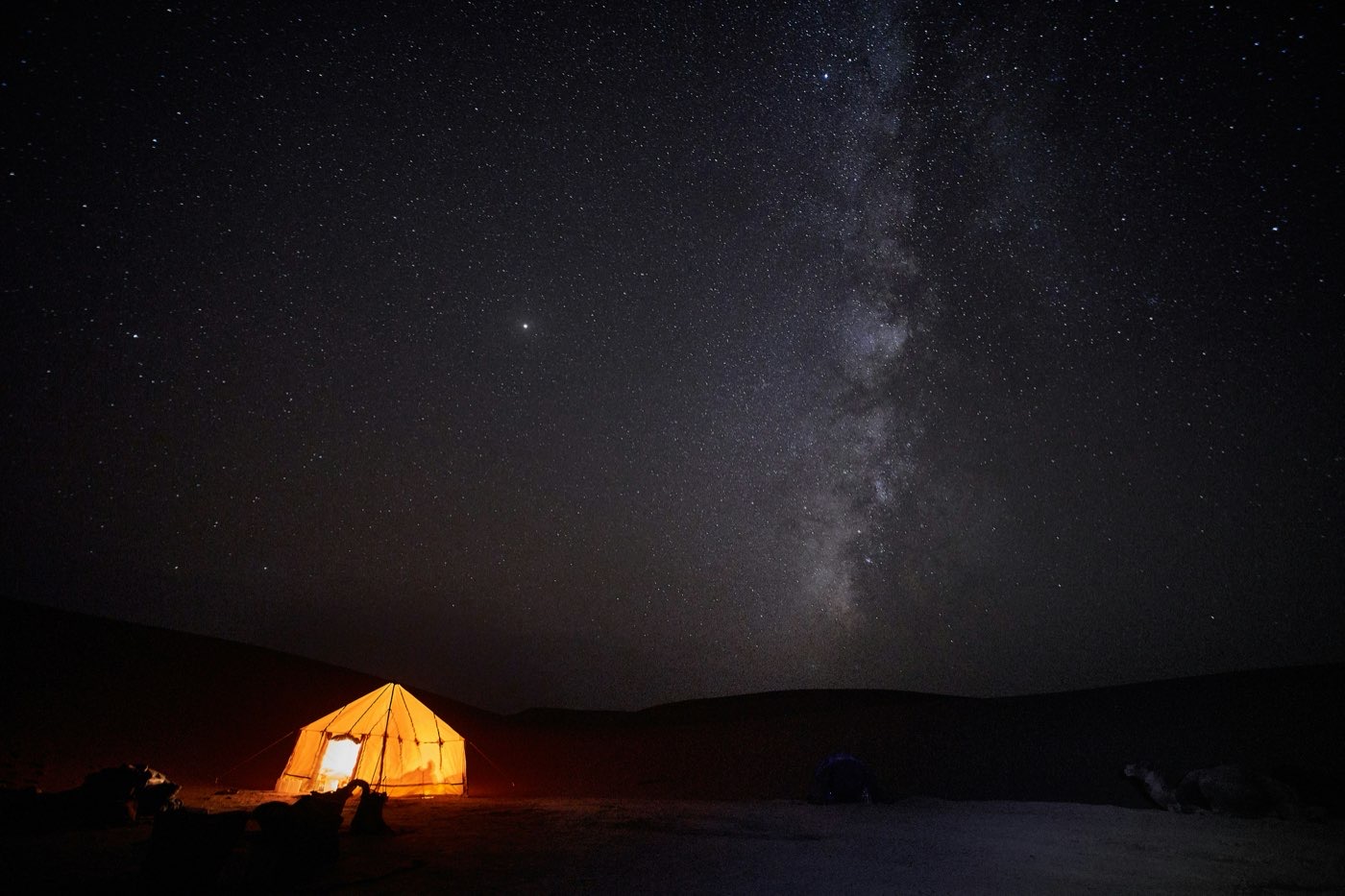
Most people who plan a Wadi Rum visit think primarily about the daytime landscape - the rock pillars, the dunes, the jeep tours. The night sky is the part that they did not expect to care about and that they consistently describe as the most memorable element of the trip.
Wadi Rum’s darkness is not incidental. The protected area is 720 square kilometres of desert with no permanent settlements beyond Rum Village, and Rum Village has no industrial lighting. The nearest city of any size is Aqaba, 70 kilometres to the south. The sky above the protected area rates at Bortle Class 1–2 on the astronomer’s scale - exceptional to excellent dark sky, the kind of conditions that have become rare in most of the world and virtually nonexistent in or near European and North American cities.
What You Can See
The Milky Way: Visible to the naked eye across most clear nights from September through April, and from late August through May in good years. What you see is the galactic disc - a dense, irregular band of light arcing across the sky from one horizon to the other. The core (the direction toward the galactic centre in Sagittarius) is brightest and most detailed, rising in the south-southeast during the evening hours from September through November. By February the core is above the horizon before dawn; by April it rises around midnight. In a Bortle 1–2 sky, the texture within the Milky Way - dust lanes, star clusters, bright patches - is visible to the naked eye without any optical aid.
Andromeda Galaxy: At Bortle 1–2, the Andromeda Galaxy (M31) is visible to the naked eye as a faint smudge in the northern sky on clear nights. It is the most distant object the unaided human eye can detect - 2.5 million light years from Earth. With 8x42 binoculars, the oval shape of the galaxy becomes clear, along with hints of its satellite galaxies M32 and M110.
Planets: Jupiter, Saturn, Venus, and Mars are all bright enough to outshine most stars and are easily identified without equipment. In Wadi Rum’s dark sky, they cast faint shadows. The planets move against the background stars on a scale of weeks to months; which planets are visible in any given month depends on their orbital positions - check a current sky chart for your travel dates.
Meteor showers: Several annual showers are particularly good from Wadi Rum’s latitude. The Perseids (peak 11–13 August) are the most prolific shower of the year, with up to 100 meteors per hour at peak, but August is high season for heat - daytime temperatures exceed 40°C, making outdoor observation uncomfortable until well after midnight. The Leonids (peak 17–18 November) are more modest in number but can produce brilliant fireballs. The Geminids (peak 13–14 December) are consistently the most reliable annual shower - up to 120 meteors per hour at peak, with the radiant high in the sky during the Jordanian winter, and no heat problem.
Zodiacal light: In very dark skies in early spring and autumn, a faint pyramid of light rises from the western horizon after sunset (or eastern horizon before sunrise). This is sunlight scattered by interplanetary dust. It is visible in Wadi Rum on clear nights in February–March and September–October and is almost never seen from light-polluted environments.
Best Months for Stargazing
| Month | Milky Way Core | Temperature (Night) | Notes |
|---|---|---|---|
| September | Visible (evening, west) | 18–22°C | Good conditions, still warm |
| October | Visible (early evening) | 12–18°C | Excellent overall conditions |
| November | Low (sets early) | 6–12°C | Leonids mid-month; Milky Way fades |
| December | Below horizon (evening) | 2–8°C | Geminids 13–14; cold nights |
| January | Pre-dawn only | 0–6°C | Very cold; coldest month |
| February | Pre-dawn rising | 3–9°C | Improving; zodiacal light visible |
| March | Pre-dawn, improving | 7–14°C | Spring; Milky Way core rises earlier |
| April | Rises around midnight | 12–18°C | Good core visibility by 1am |
| May | Rises 10–11pm | 18–24°C | Core excellent; warm nights |
The overall best months are October through December (clear skies, manageable cold, good Milky Way arc) and April through May (warm enough to sit outside comfortably, Milky Way core rising at a reasonable hour).
How to Maximise the Experience
Pick the right moon phase. This is the single most important variable and is entirely controllable. A full moon makes casual stargazing comfortable but washes out the Milky Way completely. A new moon, or the three days before and after, gives maximum darkness. Plan your Wadi Rum overnight around the lunar calendar for your travel dates.
Get away from the camp. Camp fires and LED lighting from tents reduce your night adaptation. Walk five minutes from the camp perimeter in the direction away from any light sources, let your eyes adapt for 15–20 minutes, and the sky you see will be substantially better than from the camp itself. Tell your guide you plan to walk away from camp after midnight - they are used to the request and will advise on a safe direction.
Stay up after midnight. The best conditions are typically between 11pm and 3am, when the sky is fully dark and before pre-dawn twilight begins. Most camp fire gatherings wind down around 10–11pm; the guests who see the best sky are the ones who stay up or get up in the middle of the night.
Allow 20 minutes for dark adaptation. The human eye takes 20–30 minutes to fully adapt to darkness after exposure to bright light. Using a phone screen at full brightness resets this process immediately. If you need to use your phone, switch it to red-light mode (most astronomy apps include this) or use a red-filtered headlamp.
Photography in the Wadi Rum Night Sky
Wadi Rum is among the best accessible locations in the Middle East for night sky photography. The combination of a dark sky, dramatic foreground geology, and dry clean air (low atmospheric moisture compared to coastal or tropical locations) produces images that require minimal post-processing to convey what was actually visible.
Basic settings for Milky Way photography:
- Aperture: f/2.8 or wider (f/1.8–f/2 if available)
- ISO: 3200–6400 on most modern mirrorless cameras (test your camera’s noise threshold)
- Shutter speed: 15–25 seconds (longer exposures introduce star trails on most wide lenses)
- Focus: manual focus to infinity - autofocus does not work in dark conditions
Foreground composition: The sandstone pillars and arches of Wadi Rum provide exceptional foreground elements for Milky Way compositions. Discuss with your guide the night before whether they can position the jeep to illuminate a rock formation with headlights for a long-exposure shot - many guides have done this before and are willing to help.
The 500 rule: A rough guide to maximum shutter speed before star trails appear - divide 500 by your focal length (mm). At 24mm on a full-frame camera: 500/24 ≈ 20 seconds maximum. On a crop-sensor camera, adjust the focal length by the crop factor first.
No dedicated telescope packages are required for excellent night sky photography - the naked-eye sky is already spectacular enough that a standard wide-angle lens captures an image worth having. To book a Wadi Rum overnight camp with access to the dark skies, browse Wadi Rum camp and stargazing packages.
See Also
- Wadi Rum Where to Stay
- Wadi Rum Tours and Jeep Safaris
- Wadi Rum Complete Guide
- Hot Air Balloon Rides over Wadi Rum
If you want a sealed, star-view stay, see our Wadi Rum bubble hotels guide for how they compare with traditional camps. For a night under the stars, read our Wadi Rum overnight camps guide for camp types, prices and what is included.