Dana Biosphere Reserve: Jordan's Finest Nature Reserve
Everything you need to visit Dana: entry fees, trails, Feynan Ecolodge, Dana Village guesthouses and how to get there from Amman or Petra.
Guides for Dana
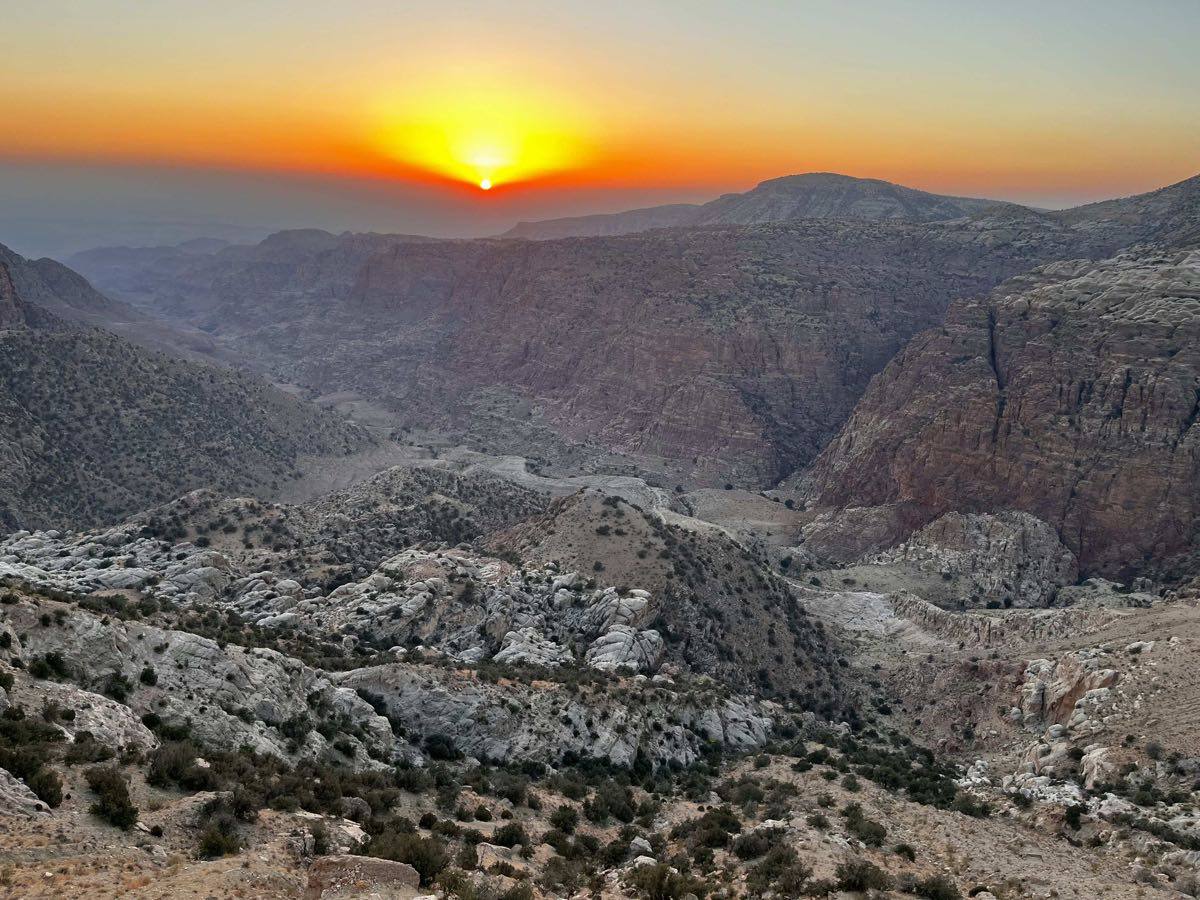
Dana Biosphere Reserve covers 320 square kilometres of some of the most varied terrain in Jordan - sandstone cliffs of deep red and ochre, wadi valleys dropping from 1,500 metres above sea level to 50 metres below it, open desert at the Wadi Araba floor, and terraced highland that the Ottoman-era village of Dana itself has occupied for at least five centuries. It is Jordan’s largest nature reserve, managed by the Royal Society for the Conservation of Nature (RSCN), and it represents a genuinely rare convergence: world-class scenery, active conservation, an inhabited traditional village, and accommodation that is among the most distinctive in the Middle East.
Most visitors to Jordan skip Dana in favour of the more famous sites. That gap in the itinerary is worth closing.
The Reserve and Its Landscape
The reserve’s dramatic altitudinal range - from alpine highlands to arid desert floor - creates four distinct ecological zones, which in turn support an unusually broad range of wildlife. Over 600 plant species have been recorded, including endemic species found nowhere else. Wolves, striped hyenas, ibex, and sand cats are all present, though sightings of larger predators require patience and luck. The birdwatching is more reliably rewarding: over 200 species have been recorded, including golden eagles, Bosporus eagles, Syrian serin, and sand partridge. Spring migration (March to May) brings additional species through the reserve in significant numbers.
The geology is as interesting as the biology. The western escarpment is Nubian sandstone, sculpted by erosion into columns, arches, and slot canyons. Moving east, the rock transitions to limestone. The Wadi Dana - the main valley cutting through the reserve - is one of the most photogenic landscapes in Jordan and visible in partial view from Dana Village itself.
Dana Village
The village is the practical and emotional centre of the reserve. A settlement of 15th-century Ottoman stone houses built into the cliffside, it was largely abandoned during the 20th century when residents moved to the modern town of Qadisiyya on the plateau above. The RSCN’s community conservation programme has brought some families back to the old village, and the stone houses have been restored as guesthouses, a visitor centre, and small artisan workshops producing herbs, dried fruits, silver jewellery, and handmade paper - all sold through the RSCN shop.
The village’s position - at the lip of the escarpment, looking west into the canyon and south towards Wadi Araba - gives views that are worth arriving early in the morning or staying for sunset to experience at their best. The quality of light at dawn and dusk across the sandstone is extraordinary.
Entry to the biosphere reserve costs approximately JOD 5 per person as of 2026, payable at the RSCN visitor centre in the village. The visitor centre also handles trail bookings, guide arrangements, and accommodation queries.
Trails
White Trail - The main descent from Dana Village into the wadi below. The trail runs 5km and takes approximately 2 hours walking steadily. The gradient is moderate with some steep sections on loose sandstone. The route passes through terraced gardens, past ruined structures, and eventually into open wadi floor with views back up to the village perched on the cliffside. You cannot easily complete a return loop - most walkers arrange a 4WD pickup from the wadi floor, or continue further west toward Feynan (a full-day commitment). Ask the visitor centre about current conditions before setting out.
Rummana Trail - A 2km loop through the woodland around the Rummana campsite, approximately 8km north of the village. Easy terrain, moderate elevation gain, and good birdwatching potential in the early morning. Well-suited to families or those who want a short walk without guide requirements.
Dana to Petra Trek - The most ambitious option: a 3 to 4 day guided trek covering approximately 75km from Dana Village through the Wadi Feynan area, across the Shara highlands, and down to Petra. The RSCN organises this as a guided, camping-supported trek; book months in advance for spring departures. Costs vary significantly by group size but budget approximately USD 200–400 per person for a guided multi-day route as of 2026.
Where to Stay
Feynan Ecolodge - Located at the desert floor of Wadi Feynan, roughly a 3 to 4 hour walk from Dana Village or accessible by 4WD via a separate approach from the east. The lodge is solar-powered during the day and lit entirely by candles after dark - there is no electricity in the rooms, which is precisely the point. The experience is genuinely immersive: guided night walks, Bedouin dinner around a fire, star observation. Rates run from approximately USD 85–110 per person full-board as of 2026. Book directly through rscn.org.jo. The lodge is the only accommodation inside the reserve proper, and it regularly sells out months in advance during spring and autumn.
Dana Guesthouses (Dana Village) - Several RSCN-managed guesthouses and private family homestays operate within the village itself, offering more basic but comfortable accommodation. Rates run approximately JOD 20–35 per person per night as of 2026, some including breakfast. Staying in the village gives you early morning and evening light on the escarpment, which is significantly better than arriving on a day trip. Book through the RSCN visitor centre or rscn.org.jo.
Rummana Campsite - Seasonal tents and basic facilities near the northern end of the reserve, typically open spring and autumn only. A cheaper option for independent travellers - approximately JOD 15–20 per person as of 2026 including tent. Check current availability with RSCN.
For booking advice, seasonal availability notes, and tips on the difference between Feynan Ecolodge and the village guesthouses, see the where to stay in Dana guide.
Search hotels in Dana Village Jordan on Booking.com
Wildlife and Birdwatching
The reserve’s wildlife is most active at dawn and dusk. Ibex - the Nubian ibex, a mountain-adapted wild goat - can sometimes be spotted on the sandstone cliffs above the village in the early morning. Wolves are present but rarely seen. The birdwatching, by contrast, is reliably productive: the RSCN operates guided birdwatching walks from the visitor centre, typically running approximately 2 hours and costing JOD 10–15 per person as of 2026 including guide.
Spring migration (March to May) is the peak period for variety, with raptors, warblers, and flycatchers moving through the reserve in numbers. Resident species including Tristram’s starling - a glossy black bird with orange wing patches - are present year-round and conspicuous around the village.
What to Buy
The RSCN shop in Dana Village sells produce made by local community members as part of the conservation-linked livelihood programme: sun-dried herbs, wild thyme, camel’s milk soap, hand-poured beeswax candles, and handmade silver jewellery. Prices are reasonable and purchases directly support families in the village. The dried herb selection - wild sage, thyme, and oregano harvested from the reserve - is particularly worth picking up.
Getting to Dana
By car: Dana is approximately 220km south of Amman on the Desert Highway, with the final approach via a turning near Qadisiyya. The total drive takes around 3 hours. The road up to Dana Village is paved but steep and narrow for the final section; ordinary vehicles manage it in dry conditions.
By public transport: There is no direct bus to Dana Village. Take any southbound service from Amman’s South Bus Station (Wahdat) towards Tafilah - journey time approximately 2 to 2.5 hours, fare approximately JOD 2.50 as of 2026. From Tafilah, shared taxis cover the 15km to Dana or Qadisiyya in approximately 30 minutes for approximately JOD 5–8 per taxi. Alternatively, contact Feynan Ecolodge when booking - they arrange transfers from various pickup points including from the Desert Highway junction and from Wadi Musa (Petra).
From Petra/Wadi Musa: Approximately 75km north, around 1 hour by car. A private taxi from Wadi Musa to Dana Village costs approximately JOD 20–30 as of 2026 depending on negotiation. Several Petra-based tour operators can also arrange day trips into the reserve. You can also browse guided King’s Highway tours that include Dana as part of a multi-day Jordan circuit.
More in Dana
Book an experience
Top experiences in Dana
Explore the best tours and activities in Dana , with instant confirmation and free cancellation on most bookings.
Frequently Asked Questions
- How do you get to Dana Biosphere Reserve?
- Dana is approximately 220km south of Amman, around 3 hours by car. There is no direct public transport to Dana Village. The nearest hub is Tafilah, from which shared taxis cover the final 15km in around 30 minutes for approximately JOD 5–8. Alternatively, arrange a transfer directly through Feynan Ecolodge when you book - they can organise 4WD pickups from Wadi Feynan or from the Dana Village area.
- Do you need to book Feynan Ecolodge in advance?
- Yes. Feynan Ecolodge is the only accommodation inside the reserve and runs at high occupancy through spring (March–May) and autumn (September–November). Book at least 4 to 6 weeks ahead for these periods via rscn.org.jo. The lodge is solar-powered and candle-lit at night, and rates are full-board, meaning meals are included.
- What is the entry fee for Dana Biosphere Reserve?
- Entry to Dana Biosphere Reserve costs approximately JOD 5 per person as of 2026, payable at the RSCN visitor centre in Dana Village. The fee supports conservation and community programmes. A Jordan Pass does not cover Dana entry - check rscn.org.jo for the most current pricing before your visit.
- What trails can you walk in Dana?
- The two most accessible trails are the White Trail (5km, approximately 2 hours, moderate gradient down into the wadi) and the Rummana Trail (2km loop, easy, through woodland around the Rummana campsite). Longer multi-day routes link Dana Village to Feynan and from there to Petra - ask the RSCN visitor centre for current conditions and guide requirements.