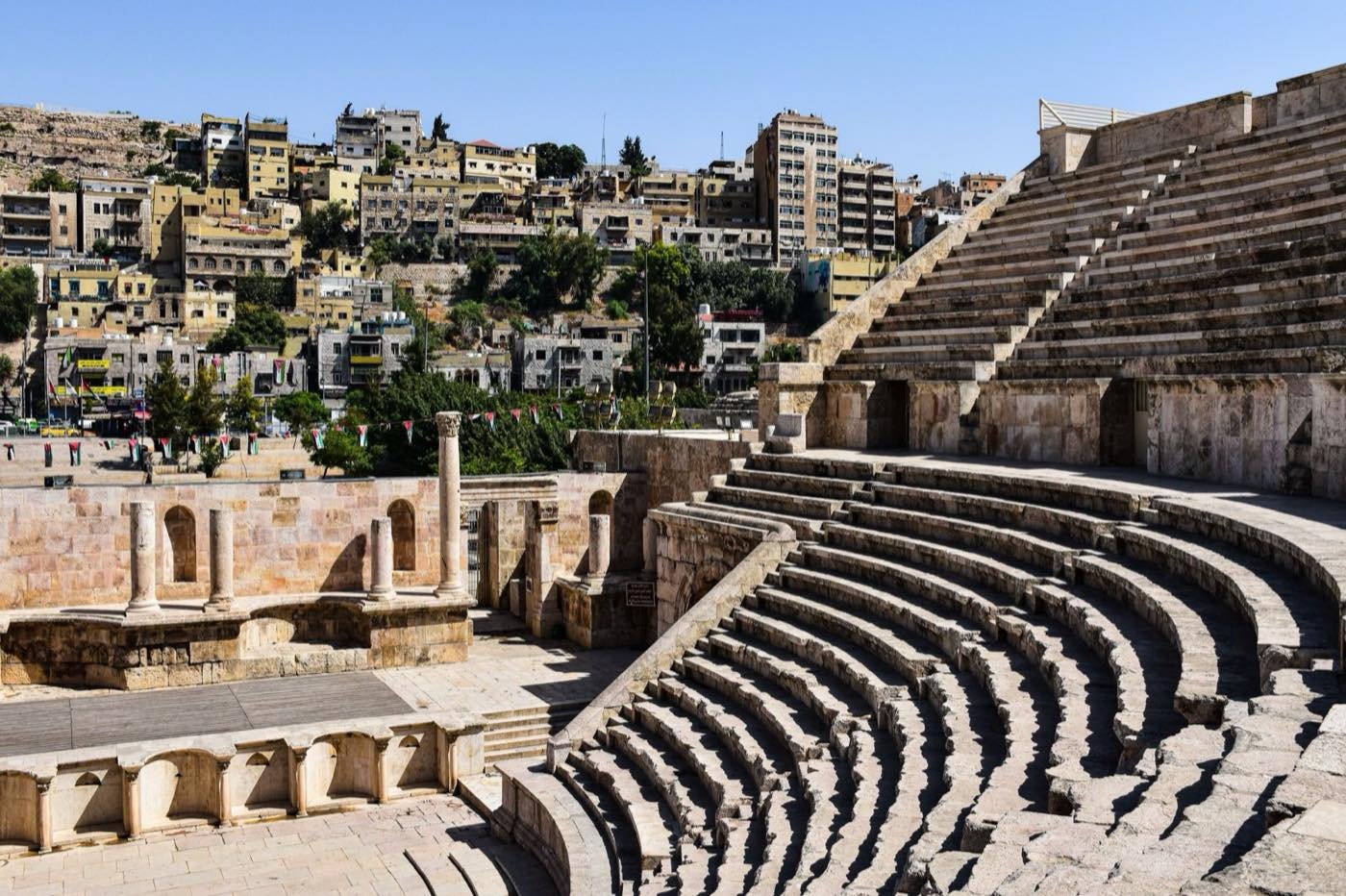
The Roman Theatre is the landmark of downtown Amman. It sits in the middle of the Balad, facing Hashemite Plaza, with the hill of the Citadel rising behind it, and it is one of the few places in the city where you can climb straight into the ancient layer of Philadelphia, as Amman was called in Roman times. This page covers what the theatre is, tickets and the Jordan Pass, opening hours, the Odeon, the Nymphaeum and the two museums built into its wings. If you also plan to see the hilltop ruins, our Amman Citadel guide covers that half of the day, and our Amman city guide places both in context.
About the theatre
The theatre dates to the second century AD, during the reign of Antoninus Pius, when Philadelphia was one of the cities of the Decapolis. It was cut into the north face of a hill, and the tiered seating still faces north, which keeps the audience out of the afternoon sun. Capacity is usually given as about 6,000, which tells you how large the Roman city was.
The seating rises in three tiers. Look for the small shrine niches carved into the upper rows, usually described as dedicated to Hercules, Athena and Dionysus, and for the stage area, which was rebuilt in modern times so concerts could be staged here again. Climb to the top rows, around 30 metres above the stage, and you get one of the best free views of the Balad, with minarets, stacked houses and the Citadel columns on the skyline. Acoustics are good enough that you can hear someone speaking from the stage when you sit at the top.
The Odeon and the Nymphaeum
Two smaller Roman monuments stand close by, and many visitors miss them.
The Odeon is a small covered theatre built in the same period, to the north-east of the main theatre. It is much smaller, seating roughly 500 people, and was used for music and council meetings rather than large shows. It sits next to the Hashemite Plaza and is easy to walk past, so spend ten minutes there.
The Nymphaeum was a monumental public fountain, dated to about the end of the second century AD. It stands a short walk away on the road towards the downtown souks. Access and restoration work vary from year to year, so treat it as an optional stop and check on the day whether you can go inside.
The two museums in the wings
The theatre’s side wings house two small museums, both reached from the theatre complex and covered by the same ticket.
- Jordanian Folklore Museum: costumes, jewellery, tools and household objects of Bedouin and village life, which gives useful context if you are heading south to Wadi Rum or Petra.
- Museum of Popular Traditions: traditional dress, embroidery, musical instruments and a few well-known mosaic pieces. It is quiet and rarely crowded.
Together they take 30 to 45 minutes. If you only have a short stop in the city, you can skip them, but they are included in the price. For the larger national collection, the Jordan Museum in the lower city is the better choice.
Tickets and the Jordan Pass
Entry for foreign visitors is approximately JOD 2 as of 2026, paid at the ticket window at the front of the complex. The ticket covers the theatre and the two museums. Sources differ slightly on the exact figure, so carry a few spare dinars.
The theatre is included in the Jordan Pass. If you already hold one for Petra, there is nothing more to pay, and our Jordan Pass guide explains which tier to buy. You do not need to book ahead.
Opening hours
Published hours vary between sources, so use these only as a rough guide:
| Season | Typical hours |
|---|---|
| Summer (about April to October) | roughly 08:00 to 18:30 |
| Winter (about November to March) | roughly 08:00 to 16:00 |
| Ramadan and public holidays | shortened hours |
Confirm at the gate, particularly in winter, when the last entry can be earlier. For holiday closures see Jordan public holidays. The plaza outside is open at all hours and is lively on summer evenings.
Walking between the theatre and the Citadel
The Citadel and the theatre are close but separated by a steep slope. Walking up from the theatre takes about 15 to 25 minutes on roads and stairs, and it is hard work in summer heat. The easy plan is to take a taxi up to the Citadel, spend the morning on the ruins, then walk down and finish at the theatre. The Citadel page covers that route in detail, and our 3 days in Amman itinerary fits both into one day.
Is it worth the stop?
Yes, with realistic expectations. The theatre is not as large or as complete as the Roman sites at Jerash, and the setting is a busy modern downtown rather than an archaeological park. What makes it worthwhile is how easy it is: you can see the whole structure in under an hour, it costs little, and it sits in the most walkable part of the city. It also pairs naturally with the Citadel, so the two together give a complete picture of Roman and early Islamic Amman in half a day.
If your time is tight, prioritise the climb to the upper rows and the view, then take ten minutes in the Odeon. Add the museums only if you want a first look at Jordanian everyday heritage before travelling on. Families with children usually enjoy the open seating, though the steep steps need supervision. Visitors with limited mobility can see the stage level and the plaza, but the upper rows have no lift.
Getting there and what is nearby
The theatre is in the Balad, a short taxi ride from Rainbow Street and Jabal Amman, and a few minutes on foot from the Al-Husseini Mosque and the gold and spice souks. Hashemite Plaza in front of the theatre is a good place to start a downtown walk. Eat nearby at the old falafel and hummus restaurants on the lanes behind the plaza; a meal costs approximately JOD 3 to 6 as of 2026. If you are on a short stopover, our Amman layover guide shows how to fit the theatre into six hours.
Tips for visiting
- Go late in the day. In summer the stone seats are hot at midday, and the light is best in the late afternoon.
- Wear sturdy shoes. The steps are steep and uneven, and some rows have no railing.
- Take a guide if you want the history. On-site signage is limited. Our Amman downtown walking and food tour combines the theatre, the souks and street food, and a wider guided tour of Amman usually adds the Citadel.
- Check events. Concerts and festivals are sometimes staged here, so check the Jordan Tourism Board’s official Visit Jordan site for listings.
Prices and hours were checked against published sources in November 2026 and may change.