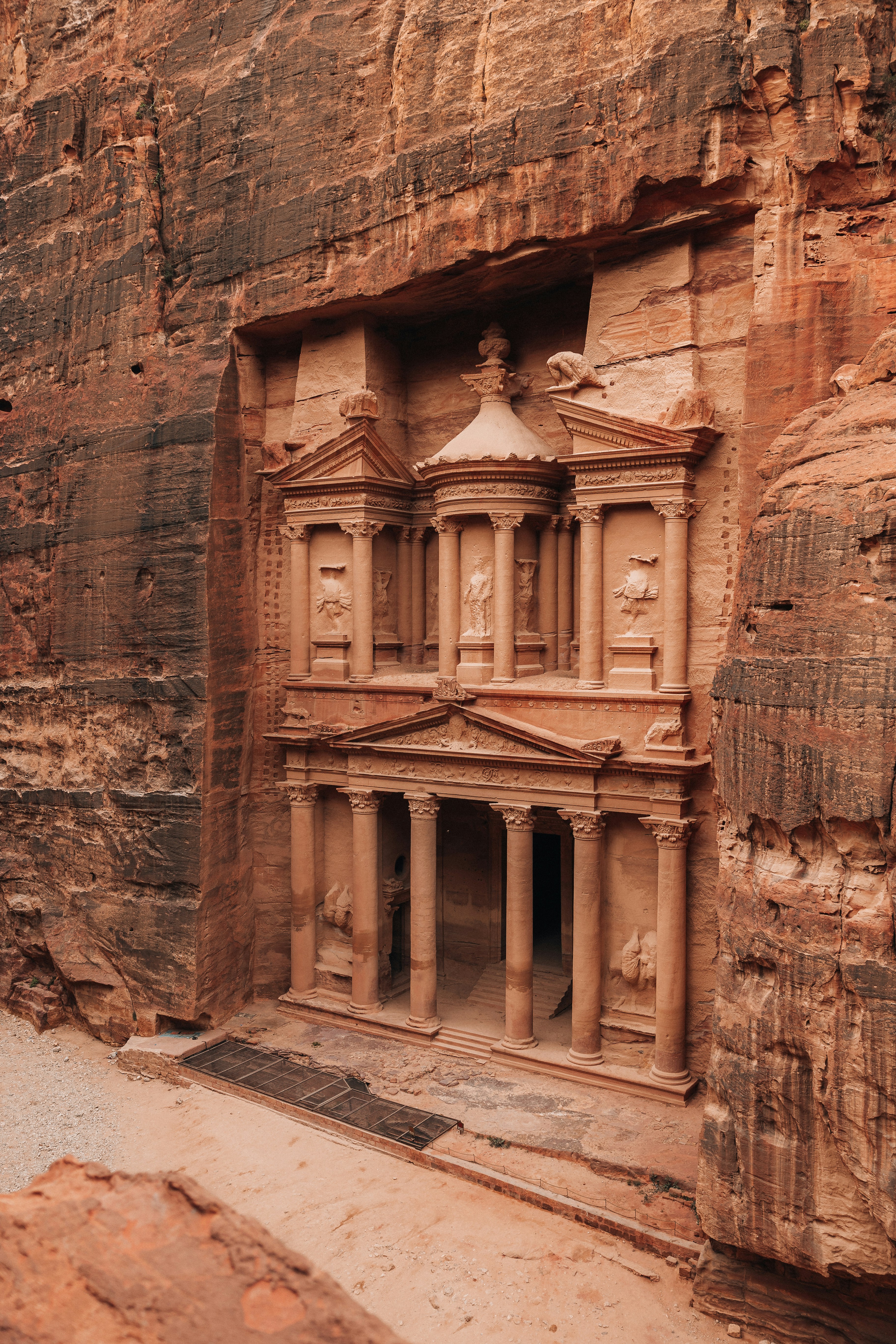
Ad-Deir - “the Monastery” - is Petra’s largest carved monument and, for many visitors, its most impressive. The facade stands approximately 47m high and 48m wide, larger even than the Treasury. Unlike the Treasury, which you reach at the end of the Siq with crowds already in place, the Monastery sits at the end of a proper hike - which means you arrive having earned it, often with fewer people around you. If you prefer a guide, browse Petra tours or the Petra day trip from Amman.
The hike is achievable for any visitor in reasonable fitness. It is not a technical climb; the path is a staircase, wide, well-maintained, and with regular rest stops. But it is 850 steps and a 200m ascent, and in summer heat that is a serious undertaking without preparation.
Getting to the Start of the Trail
The Monastery trail begins at the Basin Restaurant, located in the heart of the Petra valley approximately 1km beyond the Colonnaded Street. From the Petra Visitor Centre entrance, allow 30–40 minutes of walking at a comfortable pace to reach the Basin - or take a horse carriage (approximately JOD 20–25 one way as of 2026) for the initial flat sections.
At the Basin Restaurant there is water, toilets, and a small café. Fill your bottles here. The trail itself has no facilities until you reach the top, where a handful of Bedouin tea vendors operate at the plateau.
The Hike: What to Expect
The route is signposted and follows a single path - you cannot get lost. The initial section passes through a narrow wadi with rocky walls on both sides before the staircase proper begins.
Lower section (approximately 20 minutes): Wide rock steps in reasonable shade, particularly in the morning. The gradient is steady but not aggressive. Small niches and carvings appear on either side - miniature Nabataean rock-cut structures that hint at what lies ahead.
Middle section (approximately 20–30 minutes): The steps become more exposed. A few viewpoints open to the left showing the Petra valley - Umm al-Biyara (the enormous flat-topped sandstone mountain) and the Colonnaded Street below. There are several natural flat rocks where you can rest. Bedouin families occasionally set up impromptu tea stops with cold drinks at JOD 1–2.
Upper section (approximately 10–15 minutes): The steps level out briefly before a final short ascent to the plateau. The Monastery appears around a corner rather than at the top of the stairs - the first view is always a surprise.
At the Top
Ad-Deir fills an entire natural bowl. The facade was carved during the Nabataean period (approximately 1st century BC to 1st century AD) and functioned as a religious monument - the interior is a single large chamber with a niche for a deity or royal cult figure. Unlike the Treasury, there is no burial chamber.
Viewpoint: Walk to the left of the Monastery (from the front) for approximately 200m to reach a natural rock ledge with a view across the Wadi Arabah towards Israel. On a clear day you can see for 60–70km. This viewpoint is much less visited than the Monastery facade itself.
The tea stop: Several Bedouin locals have set up small tables at the plateau with cold drinks, sweet Bedouin tea, and simple snacks. Prices are typically JOD 2–5. This is not a commercial establishment - just local families who have been running this informal operation for years. The tea is excellent.
Time at the top: Most visitors spend 30–60 minutes at the Monastery. There is no guided content here (unless you hired a guide for the full Petra visit) - the monument speaks for itself.
Best Time of Day
Morning (opening–10am): The ideal window. The facade is in shadow until around 8:30–9am, when the sun catches the upper portions. The climb is cool, crowds are at their lowest for the morning, and you have the best light for photography.
Late afternoon (3pm–close): The second-best window. The afternoon sun illuminates the facade directly and the light is warmer. The crowds thin again after 3pm as day visitors begin heading back. If your Petra visit includes multiple days (recommended), save the Monastery for late afternoon on day two.
Midday in summer: Avoid if possible. The upper section of the trail has no shade and the exposed sandstone radiates heat in July and August. The round trip adds perhaps 600–700 calories of exertion to an already demanding day. If you must visit midday in summer, start no later than 6:30am to complete the hike before 10am.
Practical Information
Entry fee: Ad-Deir is within the Petra Archaeological Park. Entry costs approximately JOD 50 for one day, JOD 55 for two days, and JOD 60 for three days as of 2026. The Jordan Pass (from JOD 70 as of 2026) includes Petra entry for one, two, or three days plus the Jordan visa fee - worth calculating if you plan to spend two or more days in Petra. Staying overnight saves time on the trail: find hotels in Petra on Booking.com.
Opening hours: Petra opens at 6am and closes at dusk (approximately 6pm in summer, earlier in winter). The Monastery trail closes at the same time as the site.
Guides: Hiring a local guide for the full Petra visit (approximately JOD 50–80 for a half day as of 2026) adds historical context to the Monastery that you cannot get from signage alone. If budget is a concern, a guide for just the Monastery hike can often be arranged at the Basin Restaurant for less. Browse Petra guided tours including the Monastery on GetYourGuide for vetted operators with advance pricing. Pre-booked options are listed under Petra tours, and the group day trip from Amman covers transport and entry planning.
Water: Carry at least 1.5 litres per person for the Monastery hike alone. In spring and summer, 2 litres is safer. The Basin Restaurant sells water if you need to top up before starting.
Donkeys: Available at the Basin Restaurant for the ascent. If using one, keep the animal’s condition in mind - overloaded animals on steep steps are a genuine welfare concern at some operations. Walking is not difficult for most visitors.
Combining the Monastery with the Rest of Petra
The Monastery hike works best as a dedicated morning or afternoon. A full Petra day that includes the Siq, the Treasury, the Colonnaded Street, the Royal Tombs, and the Monastery is long - 10–12km of walking with significant elevation change. This is achievable for fit visitors but exhausting in summer.
If you have one day: Arrive at 6am. Walk the Siq and spend 30–45 minutes at the Treasury before crowds arrive. Proceed through the city to the Colonnaded Street and the Basin (allow 1.5–2 hours). Do the Monastery hike. Return via the Royal Tombs trail (a different route from the main path - ask at the Basin). You will finish around 2–3pm.
If you have two days: Spend day one on the Treasury, High Place of Sacrifice, Royal Tombs, and Petra Church. Save the full morning of day two for the Monastery. This is the better approach for a proper experience of both.