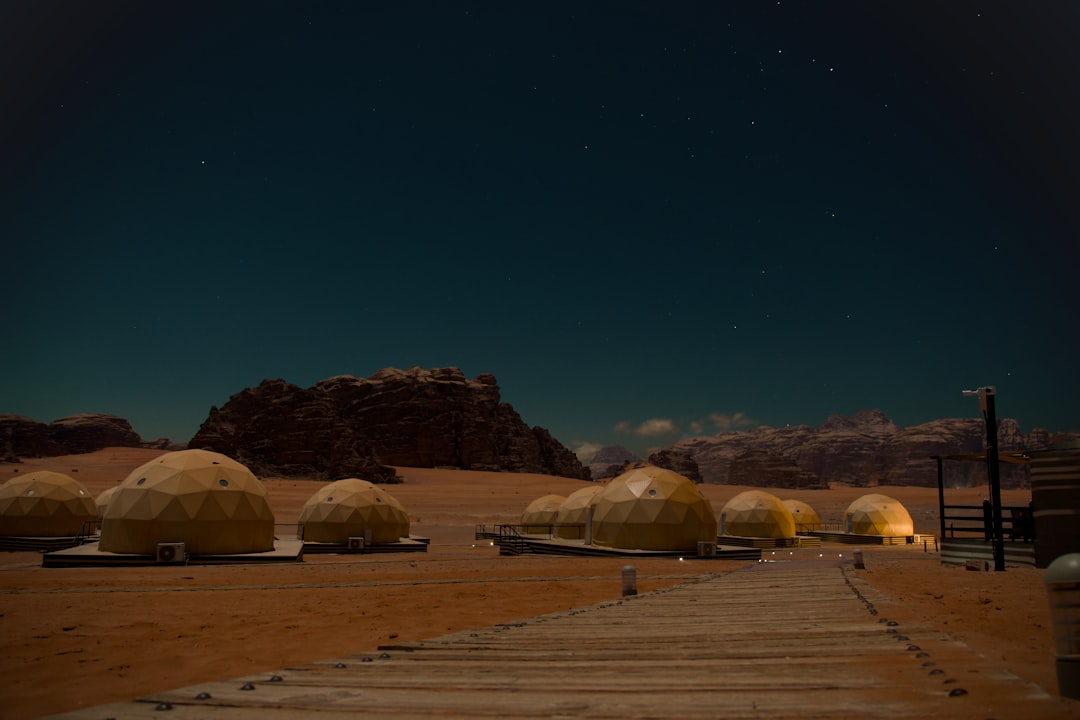
Wadi Rum is a protected area of desert in southern Jordan covering around 720 square kilometres. There are no paved roads inside the reserve, no bus services, and no street signs. Getting around means either joining a jeep tour operated by local Bedouin guides or - in very limited circumstances - driving yourself on one of the sandy tracks.
Getting to Wadi Rum
Wadi Rum village sits at the end of a well-signposted road 60 km northeast of Aqaba on the Desert Highway. There is no train and no direct public bus from Amman or Petra.
From Aqaba: The most common approach. Private taxis from Aqaba city centre to Wadi Rum village cost approximately JOD 30 to 40 and take around 50 to 60 minutes. Many camps include an Aqaba pickup as part of their overnight package. A pre-booked transfer from Aqaba is the most reliable option for an early-morning arrival in peak season (March to May, September to November) when taxis are in high demand.
From Petra (Wadi Musa): Wadi Musa is approximately 100 km north of Wadi Rum by road. A private taxi costs JOD 50 to 60 and takes around 1.5 hours. There is no direct public transport between Wadi Musa and Wadi Rum. Your Petra accommodation can usually arrange a taxi at a fixed rate, and many operators offer combined Petra and Wadi Rum packages that include the transfer between the two.
From Amman: The drive from Amman is approximately 330 km via the Desert Highway (Route 15) and takes around 3.5 to 4 hours. Hiring a car in Jordan gives the flexibility to stop at Petra or Dana en route. The reserve’s entrance road is paved and parking at the Visitor Centre is free.
From Amman by public transport: No direct service exists. The practical route is JETT bus from Abdali terminal to Aqaba (approximately JOD 7 to 9, around 4 hours), then a private taxi from Aqaba bus station to Wadi Rum village (JOD 30 to 40, around 1 hour). Allow half a day and plan to arrive in Aqaba before 15:00 to secure an onward taxi with daylight remaining.
Entry to Wadi Rum Protected Area
The main gate to Wadi Rum is at Wadi Rum village, about 60 km north of Aqaba and 100 km south of Petra. The entry fee as of 2026 is approximately JOD 5 per person, or free for Jordan Pass holders (the Jordan Pass does not cover jeep tours or camp accommodation).
The Visitor Centre at the gate is where most jeep tour bookings are finalised or picked up. If you have not pre-booked, operators queue outside and prices are negotiable. Peak season is March to May and September to November; in those months, pre-booking is strongly recommended.
Jeep Tours
Jeep tours (typically Toyota Land Cruisers or Isuzu pickups) are the primary way to reach Wadi Rum’s main sites. Distances between formations are far greater than they appear on maps - a group of rock arches that looks nearby may be 15 km across sand. The jeeps are driven by Bedouin guides who know the desert from childhood.
Standard itineraries and approximate prices as of 2026:
| Tour type | Duration | Shared group price per person | Private price |
|---|---|---|---|
| Short tour | 2 hours | JOD 35 to 50 | JOD 70 to 90 |
| Half-day tour | 4 hours | JOD 45 to 60 | JOD 90 to 120 |
| Full-day tour | 8 hours | JOD 65 to 90 | JOD 130 to 180 |
| Overnight + full day | 24 hours | JOD 80 to 110 | JOD 160 to 200+ |
Reputable operators with established track records include Wadi Rum Moon (wadirum-moon.com), Wadi Rum Nomads (wadirumnomads.com), and Rum Stars Camp (rumstarscamp.com). All three have English-speaking guides and transparent pricing on their websites. Booking directly with a camp often gives a better rate than third-party booking platforms.
A typical full-day tour covers: Lawrence’s Spring, Khazali Canyon (ancient Nabataean and Thamudic inscriptions), the massive sand dunes at Erg, Um Fruth Rock Bridge, and Burdah Rock Bridge. The Monastery and Khazali inscriptions require guides by law.
Overnight Desert Camps
Spending at least one night in a Wadi Rum camp is the best way to experience the desert. Days in camp start before sunrise and end after dark, allowing you to see the colour of the sand shift from rust to deep orange to purple as the light changes.
Camp types range from basic Bedouin tents (mattress on ground, shared bathroom block) to fully equipped glamping domes with en-suite shower and electricity.
Camp tiers and approximate prices as of 2026:
| Camp tier | Price per person per night | Examples |
|---|---|---|
| Basic Bedouin tent | JOD 25 to 40 | Rum Bedouin Camp, Al-Rashid Camp |
| Standard tent with facilities | JOD 45 to 65 | Wadi Rum Quiet Village, Bedouin Lifestyle Camp |
| Bubble tent / glamping dome | JOD 90 to 150 | Wadi Rum Night Luxury Camp, Sun City Camp |
Most camp prices include dinner (Zarb - meat and vegetables slow-cooked underground in a sand pit) and breakfast. The Zarb is one of the highlights of a Wadi Rum stay and worth choosing a camp that prepares it on-site rather than importing pre-cooked food.
Hot Air Balloons
Royal Aerostar (royalaerostar.com) is the main balloon operator in Wadi Rum. Flights run in the early morning (typically 05:30 to 07:00 takeoff) to catch the calm air and best light. A standard flight covers about 45 to 60 minutes in the air over the protected area.
Prices as of 2026: approximately USD 175 to 200 per person. Pickup is included from Wadi Musa or Aqaba hotels. The flight is weather-dependent and may be rescheduled if conditions are unsuitable - ask about their rebooking policy before you pay. Book at least 2 to 3 weeks ahead in peak season.
Camel Treks
Camel treks are offered by most Bedouin operators as either a standalone activity or an add-on to a jeep day. A 1-hour camel ride costs approximately JOD 15 to 25 per person. A half-day camel trek (3 to 4 hours) runs around JOD 50 to 70.
Camels are also used for sunset rides to the dunes, which is one of the most popular add-ons to an afternoon jeep tour. Agree on the duration and total price before mounting.
Self-Drive Rules
Private vehicles are permitted inside Wadi Rum Protected Area on the main sandy track to the Visitor Centre. Beyond that, you are technically not permitted to drive independently without a registered guide or operator accompanying you.
In practice, some visitors do enter by private car, but getting stuck in soft sand is a real risk (and expensive to resolve), the main sites are not signposted, and navigation apps do not work reliably off-track. We recommend against self-driving inside the reserve unless you have desert driving experience and a local contact.
If you are driving to Wadi Rum from Petra or Aqaba, park at the Visitor Centre and join a tour from there.
Practical Notes
Bring cash. Very few camps accept card payment, and there is no ATM inside the reserve. Stock up in Aqaba or Wadi Musa before arriving.
Mobile signal is minimal inside the protected area. Download any maps or guides offline before entering.
In summer (June to August), temperatures inside the jeep can reach 40 to 43°C by noon. Full-day tours in this period are brutal; consider a sunrise half-day tour instead, returning to camp or Aqaba before the midday heat.